English


Views: 0 Author: Site Editor Publish Time: 2026-08-10 Origin: Site


Precision irrigation transforms agricultural yields and commercial landscapes, but only upon a reliable foundation. Heavywall drip line serves as the industry standard for multi-season, permanent, and subsurface applications. Harsh field environments constantly threaten fragile tubing. If lines fail, you face catastrophic water loss, compromised crops, and massive replacement headaches. Selecting the correct system requires balancing upfront investments against long-term operational longevity, maintenance reduction, and landscape uniformity. You must evaluate competing materials and specifications carefully to avoid costly mistakes. This article provides an evidence-based framework for assessing technical specifications, emitter variations, and installation realities. We will explore how to match emitter flow rates to soil types and protect your system from root intrusion. Read on to discover actionable strategies ensuring optimal performance and maximum yield from your permanent irrigation infrastructure.
Heavywall drip lines (typically 35–45+ mil) are built for multi-year durability, outlasting standard thinwall drip tape in permanent orchards, vineyards, and commercial landscapes.
Pressure Compensating (PC) emitters are essential for sloping terrain and long lateral runs, while Non-PC lines offer cost savings strictly for flat topographies.
Emitter spacing and flow rates must be mathematically matched to soil composition (capillary action) and peak crop water demand, not just hardware availability.
Subsurface installations (SDI) require specific anti-siphon (AS) and root-guard features to prevent catastrophic system failure.
System longevity is heavily dependent on auxiliary infrastructure, specifically proper filtration thresholds (e.g., 120-mesh) and air/vacuum relief valves.
Permanent crops demand permanent infrastructure. You cannot rely on fragile materials for decades-long growth. Heavywall systems represent a long-term operational commitment. They typically offer a 10-year to 25-year lifespan. Manufacturers engineer these robust tubes to withstand harsh UV exposure. They also resist heavy mechanical impacts from tractors and harvesters. In contrast, thinwall drip tape serves seasonal row crops perfectly. However, thinwall tape remains highly susceptible to insect damage, bird strikes, and mechanical tearing.
Target applications for heavywall systems include orchards, vineyards, and permanent row crops. Municipal landscape zones also benefit heavily from this durability. City parks experience high foot traffic. Landscapers require tough irrigation lines to prevent accidental ruptures. Installing heavywall tubing beneath mulch layers ensures reliable watering across expansive commercial properties.
System Type | Typical Lifespan | Primary Applications | Vulnerability Level |
|---|---|---|---|
Heavywall Tubing | 10 - 25 Years | Orchards, Vineyards, Parks | Low (Highly Resilient) |
Thinwall Tape | 1 - 3 Seasons | Seasonal Vegetables, Row Crops | High (Easily Damaged) |
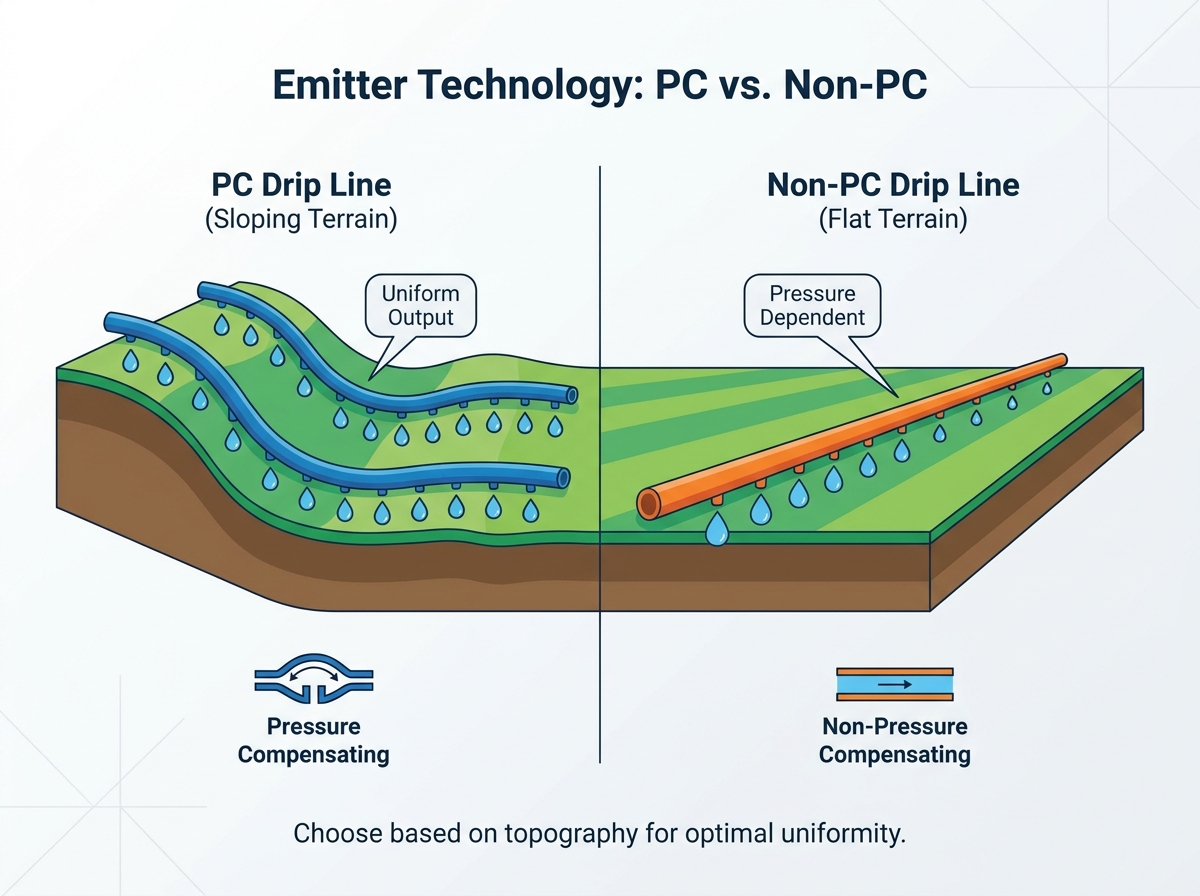
Pressure Compensating emitters utilize an internal silicone diaphragm. This small mechanism flexes continuously during operation. It regulates flow despite pressure fluctuations inside the tube. If system pressure spikes, the diaphragm restricts the flow path slightly. If pressure drops, it opens wider. This ensures every single plant receives the exact same amount of water.
You must evaluate your topography carefully. PC systems are mandatory for undulating terrain. They remain essential for steep slopes or exceptionally long lateral runs. Emission uniformity is critical in these scenarios. Without PC technology, crops at the bottom of a hill receive too much water. Plants at the top suffer from drought.
However, PC technology involves specific trade-offs. These systems carry a higher initial material cost. They also require a slightly higher minimum operating pressure. You must hit this threshold to activate the compensation mechanism successfully.
Best Practices: Always map field elevation changes before ordering. If your elevation changes more than five feet across a zone, default to PC emitters.
Common Mistakes: Using PC emitters on low-pressure gravity feed systems. The water pressure often fails to open the silicone diaphragm, causing zero emission.
Non-PC lines operate on a much simpler principle. The flow rate relies entirely on the system pressure at the specific emitter point. Higher pressure equals higher water output. Lower pressure equals lower water output.
This technology remains viable only under strict conditions. You should only use Non-PC lines for laser-leveled fields. They also work well on strictly flat terrain utilizing short run lengths. Under these perfect conditions, the pressure stays relatively constant across the whole zone.
The primary trade-off involves risk management. You gain a lower upfront material cost. However, you introduce significant risks of uneven water distribution. Nutrient distribution also suffers if pressure drops near the end of the line. Your crop yield could become highly inconsistent.
Industry standards classify wall thickness using "mil" ratings. One mil equals one-thousandth of an inch. Heavywall classifications typically range from 35 mil to 45+ mil. Some commercial landscaping tubes reach 45 to 60 mil.
This thickness maps directly to physical resilience. Thicker walls withstand heavy tractor traffic. They resist gnawing attempts from field rodents. High operating pressures require robust walls to prevent bursting. A 45-mil tube handles intense pressure surges much better than a 35-mil tube.
You must match emitter flow rates to your specific soil type. This prevents wasteful surface runoff. It also ensures proper lateral water spread through capillary action.
Heavy Clay Soils: Use low flow rates (e.g., 0.26 to 0.4 GPH). Clay absorbs water slowly. High flow causes immediate puddling and runoff.
Loamy Soils: Use medium flow rates (e.g., 0.5 to 0.6 GPH). Loam offers balanced absorption and drainage.
Sandy Soils: Use higher flow rates (e.g., 0.9 to 1.0 GPH). Sand drains rapidly straight down. High flow forces the water to spread horizontally before sinking.
Spacing calculation logic depends on plant density and root structures. Closer spacing (12 to 18 inches) suits high-density plantings. It also works perfectly for sandy soil, creating a continuous wetted strip. Wider spacing (24 to 36 inches) suits deep-rooted permanent crops. Trees in loamy or clay soils thrive on wider spacing patterns. The overlapping moisture plumes eventually meet underground.
Permanent systems demand rigorous filtration. You must check the manufacturer's required filtration threshold. Most heavywall lines require 120-mesh (130-micron) filtration. Failing to install proper filters voids manufacturer warranties immediately.
Modern internal emitters feature advanced turbulent flow paths. Water spins rapidly inside the emitter chamber. This turbulence keeps fine particulates suspended. Self-flushing mechanisms occasionally purge trapped debris. These features resist particulate buildup effectively over many years.
Subsurface Drip Irrigation (SDI) places lines directly into the root zone. This technique maximizes water efficiency. However, it introduces complex physics during system shutdown. When the irrigation pump turns off, water drains to the lowest field point. This drainage creates a powerful internal vacuum.
Without protection, this vacuum sucks wet soil directly into the emitters. Mud fills the tiny chambers, ruining the system permanently. Anti-Siphon (AS) mechanisms solve this problem. These specialized emitters close tightly the moment line pressure drops. They prevent the tube from ingesting surrounding soil and debris upon shutdown.
Best Practices: Always pair AS emitters with proper air relief valves. The valves break the vacuum at the pipe level, supporting the AS function.
Roots naturally seek out water sources. In subsurface applications, roots will try to grow directly inside the emitters. You must evaluate different defense strategies carefully.
Physical barriers utilize tiny flaps or specialized maze structures. These mechanical designs make root entry incredibly difficult. Chemical-infused emitters take a different approach. Manufacturers integrate herbicides, like Treflan or Trifluralin, directly into the plastic. The chemical slowly releases over decades, stunting root tip growth near the opening.
You must assess regulatory and compliance considerations before purchasing. Organic farming certifications strictly prohibit chemical-infused lines. Certain strict municipal zones also ban them. Physical barrier emitters serve as the only viable option for certified organic operations.
System integrators often overlook basic dimensions. You must ensure the selected tubing Outside Diameter (OD) and Inside Diameter (ID) match your fittings perfectly. Poly tubing sizes vary wildly between manufacturers. A 17mm insert fitting will stretch and eventually break a 16mm tube. A 16mm fitting inside a 17mm tube will leak immediately under pressure.
System collapses happen frequently due to poor air management. You must install proper air vents at all high points in the system. When the system fills, air must escape rapidly. If trapped, air pockets cause severe water hammer, blowing apart connections. When the system drains, vacuum relief valves allow air back inside. This prevents the heavywall tubing from collapsing flat under soil weight.
System hygiene dictates your long-term success. You must install flush valves at the end of every lateral run. Routine flushing forces accumulated silt and biological slime out of the lines. You must achieve a minimum flushing velocity to scour the internal walls clean. Maintaining these protocols validates manufacturer warranties and guarantees uniform water delivery. Should you require advice on optimal flushing velocity, please contact us today.
Poly tubing expands and contracts significantly with temperature changes. This represents a stubborn physical reality. If you install tubing tightly during a cold morning, it will expand under the hot afternoon sun. Conversely, hot tubing installed tightly will shrink and snap tight over winter.
Your layout must account for this movement. Installers use a technique called "snaking." They intentionally leave slight S-curves in the tubing down the crop row. This extra slack prevents tension breaks and pulled fittings during severe temperature swings.
Common Mistakes: Pulling poly tubing completely taut like a guitar string during summer installation. The first winter freeze will shrink the tubing and shear the fittings straight off the mainline.
Step 1: Baseline the Environment. Determine your exact topography. A steep slope dictates PC technology, while flat ground allows Non-PC options. Next, verify your soil type. Soil dictates your flow rate and emitter spacing.
Step 2: Define Placement. Decide between surface or subsurface installation. Subsurface placement strictly dictates Anti-Siphon and root-guard requirements. Surface placement allows simpler, standard PC emitters.
Step 3: Calculate System Hydraulics. Verify your existing pumps and mainlines. They must support the required operating pressure. They must also deliver the cumulative flow rate demanded by the heavywall system. Calculate the total gallons per minute required for your largest irrigation zone.
Step 4: Request Technical Specs. Advise buyers to request "Emission Uniformity (EU)" data before bulk ordering. Also, ask manufacturers for the coefficient of variation (Cv). A low Cv indicates high manufacturing precision, meaning every emitter performs identically out of the factory.
Heavywall infrastructure is a decades-long investment, not a disposable seasonal expense. Treat the procurement process as a permanent capital upgrade.
Optimal choices rely entirely on matching empirical site data directly with precise emitter technology. Never guess your soil composition or field slope.
Topography, soil capillary action, and water quality must dictate your wall thickness and emitter spacing decisions.
Consult an irrigation engineer to validate your hydraulic pressure requirements before full-scale procurement.
Request sample spec sheets to verify physical compatibility with your existing pumps and filtration stations.
A: Drip tape features extremely thin walls, usually between 4 and 15 mil. It serves seasonal crops and lasts only one to three years. Heavywall tubing utilizes thick plastic walls, typically 35 to 45+ mil. It incorporates rigid factory-welded emitters inside the tube. This robust construction ensures a 10- to 25-year lifespan in permanent agricultural applications.
A: A high-quality heavywall system realistically lasts between 10 and 25 years. This wide range depends heavily on maintenance routines, water quality, and environmental pressures. Frequent line flushing and strict filtration extend the lifespan significantly. High rodent pressure or aggressive mechanical weed control can shorten longevity.
A: Yes, subsurface installations are highly efficient and common. However, you absolutely must use specialized Anti-Siphon (AS) emitters. These prevent the system from sucking mud into the line during shutdown. You must also install proper vacuum relief valves on the manifolds and employ root intrusion defenses.
A: Yes, pressure regulation is vital. Heavywall systems operate within specific pressure ranges, typically between 15 and 45 PSI. You must keep PSI strictly within manufacturer specs. Excessive pressure causes blown fittings or compromises the delicate PC silicone diaphragms. Low pressure prevents PC emitters from opening properly.
A: You must adhere to mandatory filtration standards, usually installing a 120-mesh screen or disc filter. Additionally, perform routine end-of-line flushing to scour out silt. For biological slime or mineral scale, implement regular acid or chlorine injection maintenance routines based on your specific water chemistry test results.