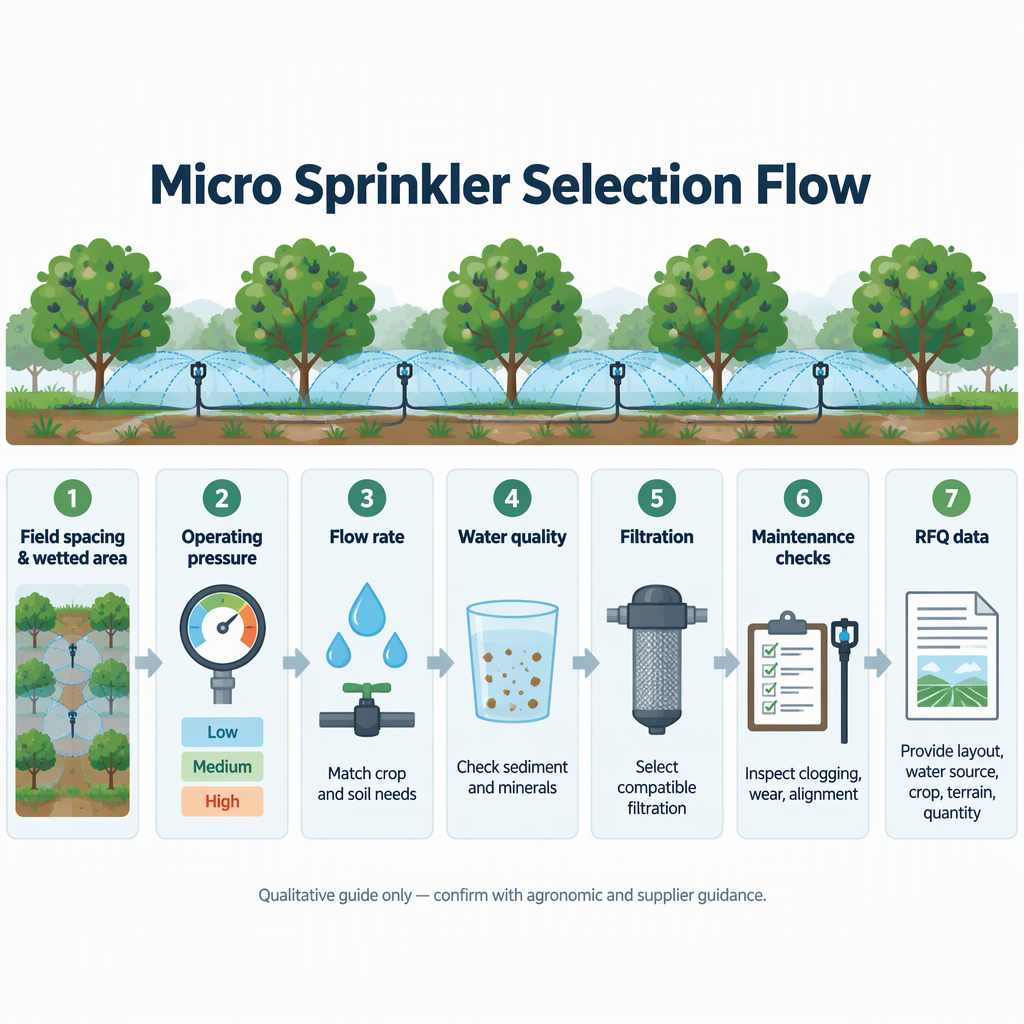
Choose micro sprinklers by first defining the wetted coverage pattern, required operating pressure, and discharge range for the field rather than selecting by product name alone. Then screen water quality, filtration, and maintenance access because clogging and discharge uniformity can determine whether the selected sprinkler remains reliable in service.
Start with the coverage pattern the field actually needs
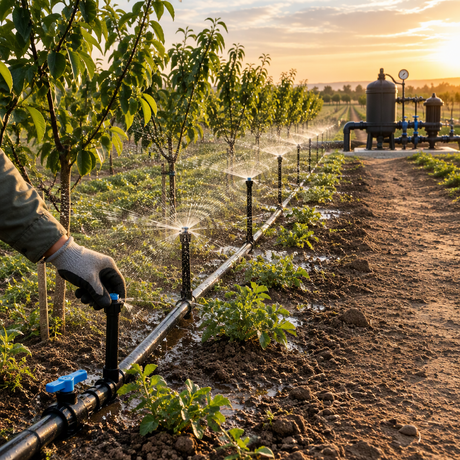
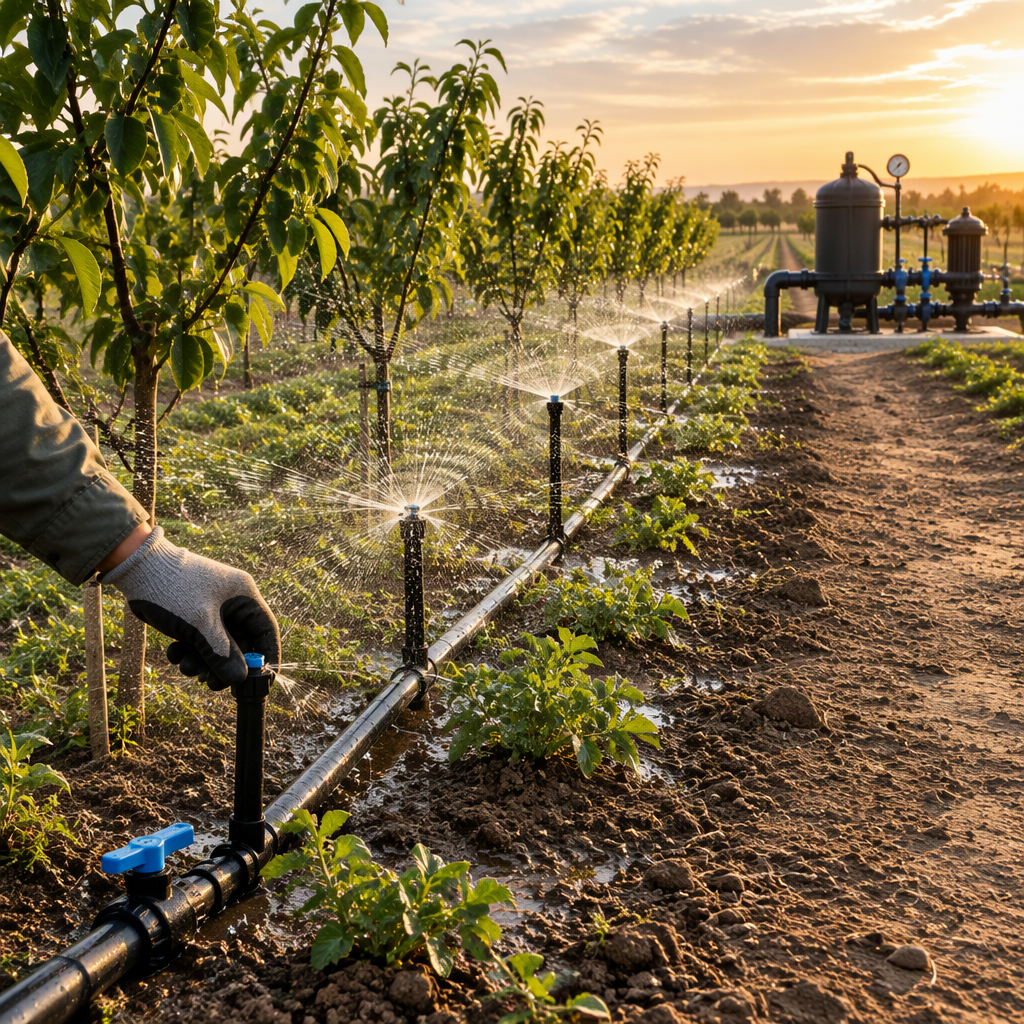
Define the target wetted area before comparing models: micro-sprinkler guidance for orchards describes typical wetted patterns of about 10 to 30 feet, so the product choice should begin with crop spacing, root-zone target, and overlap needs.
- Map the crop layout: row spacing, plant spacing, canopy position, and whether the goal is a partial wetted strip, a wider root-zone pattern, or an orchard-style circular pattern.
- Match the wetted pattern to placement: confirm whether the sprinkler will sit near the tree, between plants, on a lateral, or on a riser where the pattern can reach the intended area.
- Check overlap and edge conditions: avoid choosing only the largest nominal diameter if wind exposure, field boundaries, trunk position, or nearby equipment will interrupt the pattern.
- Record the coverage requirement in the inquiry as a target pattern, not just as a single radius, because the same field may need different throw, flow, or mounting choices.
Match operating pressure to the sprinkler, lateral, and elevation
Select a sprinkler whose manufacturer pressure range fits the field hydraulics; Colorado State University Extension notes that orchard micro-sprinklers commonly operate at low pressure, with typical operating pressure of 20 to 35 psi, and that sprinklers on a common lateral should be selected for the same pressure.
| Pressure question | Buyer check | Selection implication |
|---|---|---|
| Does the expected field pressure fall inside the sprinkler maker's stated operating range? | Compare pump, regulator, lateral, and elevation conditions against the product datasheet. | Do not accept a model only because its radius looks suitable; pressure must support the intended pattern. |
| Will several sprinklers share one lateral? | Keep sprinklers on the same lateral within compatible pressure requirements. | A mixed-pressure lateral can make uniform coverage difficult even when each individual sprinkler appears acceptable. |
| Are elevation changes or long laterals part of the block? | Ask the designer to calculate pressure at representative high, low, near, and far points. | The selected model should fit the pressure available at the sprinkler, not only the pressure at the pump. |
Check flow rate against soil, crop stage, and irrigation schedule
Micro-sprinkler selection also depends on discharge, because extension guidance describes micro-sprinkler flows ranging from low to medium volumes, including orchard discharge examples of 8 to 90 gph. The selected flow should also allow the operator to monitor discharge uniformity over time.
| Field condition | What to compare before purchase | Why it matters |
|---|---|---|
| Coarse or fast-draining soil | Coverage diameter, discharge, and schedule length | Water may need to be applied in a pattern and schedule that keeps the active root zone supplied without excessive deep movement. |
| Fine or slow-infiltration soil | Application rate relative to infiltration | A flow that is too high for the soil can create runoff or surface movement instead of useful infiltration. |
| Young crop or developing canopy | Smaller wetted target versus later expansion needs | The first selection may need to serve the present root zone while allowing a planned change as the crop matures. |
| Established crop block | Stable pattern, pressure, and discharge across the block | Uniformity matters more than a single headline radius when many sprinklers work together. |
Confirm water quality, filtration, and maintenance before purchase
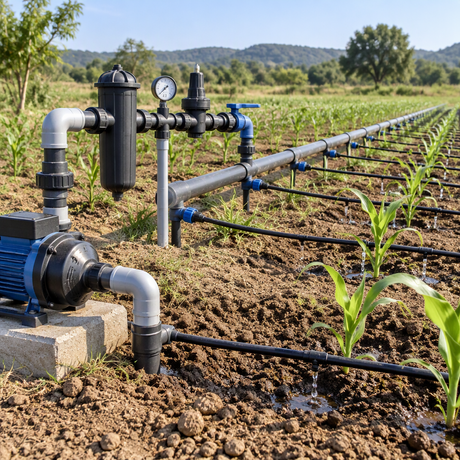
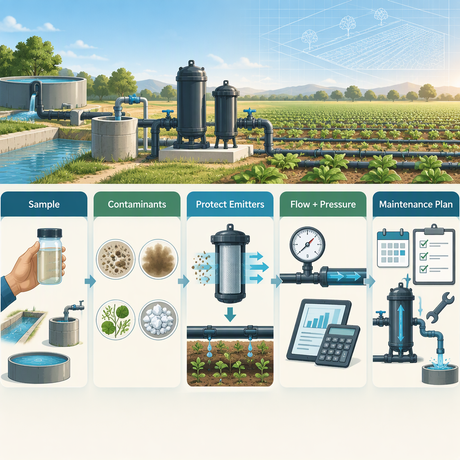
Before buying micro sprinklers, review water quality and filtration because Virginia Cooperative Extension identifies emitter plugging as a major cause of micro-irrigation failure, with physical sediment, biological or organic material, and chemical scale among the hazards.
- Identify the water source and likely plugging risks: sand, silt, organic debris, biological growth, or chemical scale.
- Compare the sprinkler emitter opening and nozzle path with the filtration level recommended by the sprinkler and filter suppliers.
- Plan how the operator will inspect filters, flush laterals, and check field discharge uniformity after installation.
- Confirm whether treatment is needed for biological or chemical hazards before the purchase order is finalized.
- Make maintenance access part of the layout review, not an afterthought after the pipe network is installed.
Prepare the RFQ data before asking for a micro sprinkler recommendation
A useful RFQ should describe the required coverage, expected pressure at the sprinkler, and target flow conditions. It should also include water-quality and filtration information so the recommendation accounts for clogging risk and maintenance.
- Crop type, row spacing, plant spacing, intended wetted area, and sprinkler mounting position.
- Available pressure range at the sprinkler location, including regulator plan, lateral length, and elevation differences.
- Target flow per sprinkler or irrigation block, plus the planned irrigation schedule or design water requirement.
- Water source, sediment load, organic or biological risk, chemical scaling risk, and the filtration equipment being considered.
- Maintenance plan for filter inspection, flushing, and discharge-uniformity checks.
- Required commercial documents: current datasheet, installation guidance, packing details, sample policy, compliance documents, and any project-specific test report the buyer needs.
DFSHOU Irrigation Technology Co., Ltd. is identified on its first-party website as a China-based custom irrigation equipment manufacturer and supplier with irrigation sprinklers, filters, PE pipes, drip irrigation systems, hydraulic control valves, and related accessories among its product areas.
Separate supplier identity from unverified product specifications
Treat supplier identity and model-level sprinkler data as two separate purchasing records: the supplier may be identified broadly, but radius, nozzle size, pressure range, filtration mesh, material, certificate, price, and lead time should come from a current datasheet or project quotation.
Conclusion
The best micro sprinkler choice is the one that fits the field's wetted-pattern target, operating pressure, lateral design, and flow requirement. It also has to fit water quality, filtration, and maintenance practices.
- Define coverage first, then check pressure and flow.
- Use field pressure at the sprinkler, not only pump pressure.
- Make filtration and maintenance part of the purchase decision.
- Request current model documents before comparing supplier quotations.
FAQs about micro sprinkler selection
These questions help distributors, farm engineers, and procurement teams turn the selection criteria into a clearer purchase specification.
Can one micro sprinkler be selected by pressure alone?
No. Pressure must be checked together with wetted pattern, discharge, lateral conditions, and crop spacing because operating pressure affects whether the sprinkler can deliver the intended coverage.
Why can a micro sprinkler system lose uniformity after installation?
Uniformity can decline when emitters or sprinkler openings plug from sediment, organic material, biological growth, or chemical scale, and when discharge uniformity and lateral pressure are not monitored.
What operating pressure range should be used as an early design reference?
For orchard micro-sprinkler guidance, a typical operating range is 20 to 35 psi, but buyers should always confirm the selected manufacturer's minimum and maximum pressure range for the exact model.
Should filtration be selected before or after the sprinkler model?
Filtration and sprinkler selection should be reviewed together because the water source, plugging hazards, and emitter opening size affect the level of filtration and maintenance needed.
Is a larger wetted diameter always the safer choice?
Not necessarily. The useful wetted area should match crop spacing, root-zone target, pressure, and flow; oversizing the pattern can waste water or create uneven overlap.
What should a distributor send when requesting a recommendation?
Send crop spacing, target wetted pattern, field pressure, lateral layout, elevation changes, and desired flow. Also send water-source and filtration details so plugging risk can be considered.
What documents should procurement request before placing an order?
Request the exact model datasheet, pressure and flow table, recommended filtration, installation guidance, packing details, compliance documents needed for the destination market, and written quotation terms.