Which water quality tests should be run before drip irrigation?
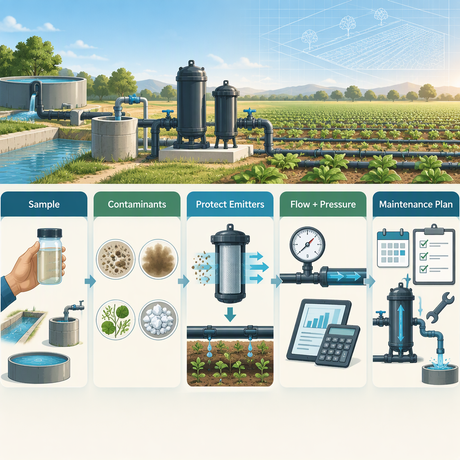
The pre-installation scope should include pH, electrical conductivity, total dissolved solids, sodium adsorption ratio, bicarbonate, carbonate, calcium, magnesium, iron, manganese, sodium, chloride, boron, nitrate-nitrogen, and relevant nutrients or trace elements. For localized drip irrigation, the same request should also support system-design decisions about clogging and operation.
| Test group | Why it belongs in the request | Buyer decision it informs |
|---|---|---|
| Salinity indicators | FAO frames salinity as one of the main potential restrictions in irrigation-water evaluation. | Confirm whether crop, soil, leaching, and management assumptions are acceptable before layout approval. |
| Infiltration-related indicators | FAO treats infiltration as a separate evaluation category from salinity and toxicity. | Ask the agronomist or designer whether soil intake and scheduling assumptions need adjustment. |
| Specific ions and nutrients | Clemson lists constituents such as sodium, chloride, boron, nitrate-nitrogen, calcium, magnesium, iron, and manganese in irrigation-water testing. | Separate crop-risk questions from emitter, filter, and maintenance questions. |
| Physical, chemical, and biological clogging contributors | FAO identifies these as clogging contributors for localized drip irrigation. | Decide whether filtration, flushing, water treatment, and maintenance provisions must be tightened before purchase approval. |
Do not stop at a short pH-only test. FAO notes that normal irrigation-water pH is generally 6.5 to 8.4 and that abnormal pH is a warning for further evaluation, so pH should trigger interpretation rather than replace the wider panel.
How should samples be collected and how many are needed?
Plan sampling by source: wells, surface water, municipal water, reservoirs, and line-end points can require different sample locations, and well-water evaluation should include one sample from each well.
- List every water source that may feed the drip block, including wells, reservoirs, surface-water intakes, and municipal supply points.
- Assign a sample location to each source that represents the water entering the irrigation system, not a convenient but unrelated tap.
- For surface water, plan seasonal testing because quality can change with source conditions.
- For shallow groundwater, consider seasonal sampling where rainfall, tides, or aquifer conditions can influence quality.
- For deeper wells, use source guidance and local professional advice because deeper wells tend to fluctuate less than surface water or shallow groundwater.
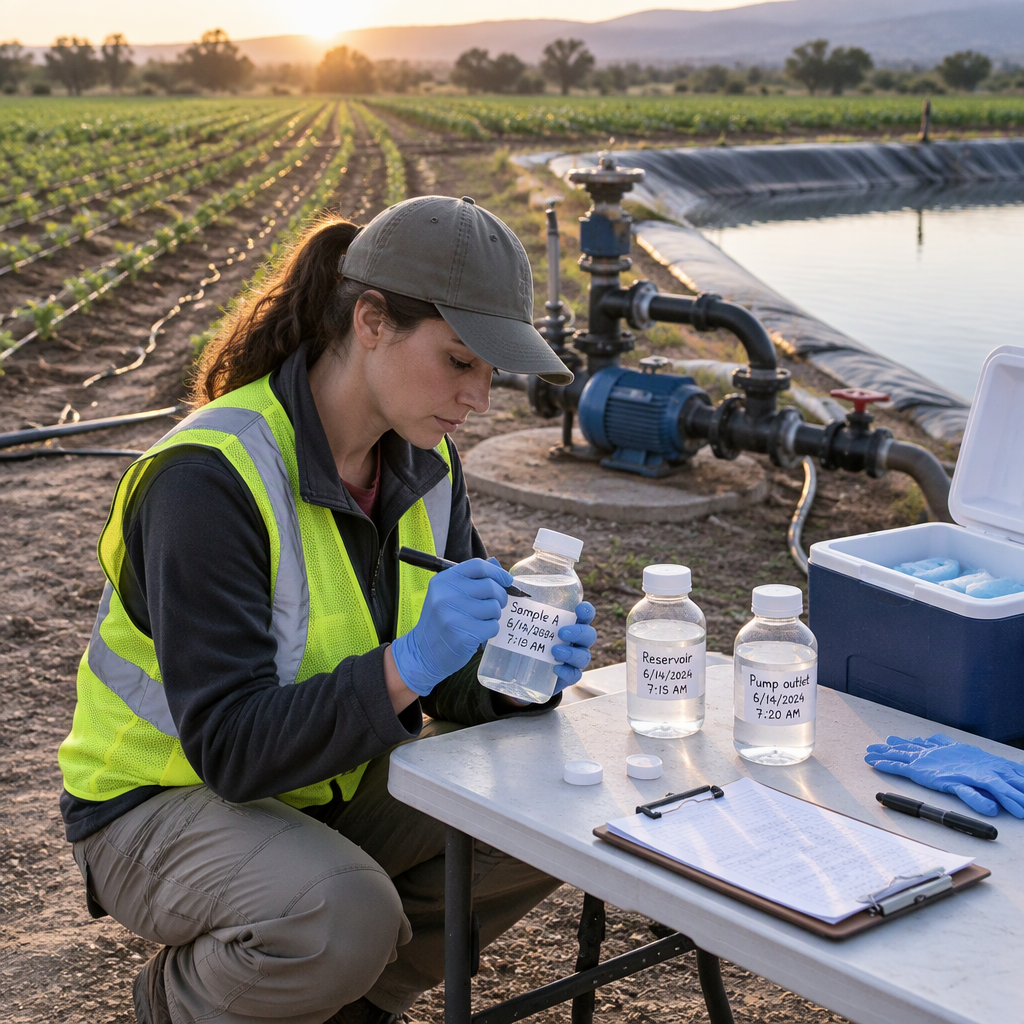
- Include sample ID, source name, location, collection date, and collector in the procurement file.
- When more than one well is available, require one sample from each well before blending assumptions are made.
- If the project depends on surface water during a long season, do not rely on one off-season result for final design acceptance.
What sample handling conditions should the lab request specify?
The lab request should specify clean containers, proper rinsing, full bottles without air space, clear labels, cooling, protection from sunlight, and lab-specific shipping instructions.
- Use clean containers, such as HDPE or other bottles cleaned as the laboratory requires.
- Triple-rinse the bottle with the source water when the laboratory protocol calls for field rinsing.
- Fill the container without air space when that is part of the lab method.
- Label the sample with the sample ID, location, date, and collector.
- Keep samples cool and out of sunlight during storage and shipment.
- Coordinate shipping and holding time with the lab for time-sensitive analyses.
The sampling and shipping instructions should come from the receiving laboratory’s current protocol and from irrigation-water sampling guidance, such as Clemson Cooperative Extension’s sampling guidance. This keeps the report traceable enough for design, procurement, and installer review.
Which results matter most for drip emitters, filters, pressure, and flow?
For drip emitters, the most important water-quality results are the ones that point to physical, chemical, and biological clogging risks. pH, bicarbonate, calcium, and sulphate conditions also matter because scale deposits can affect small drip openings.
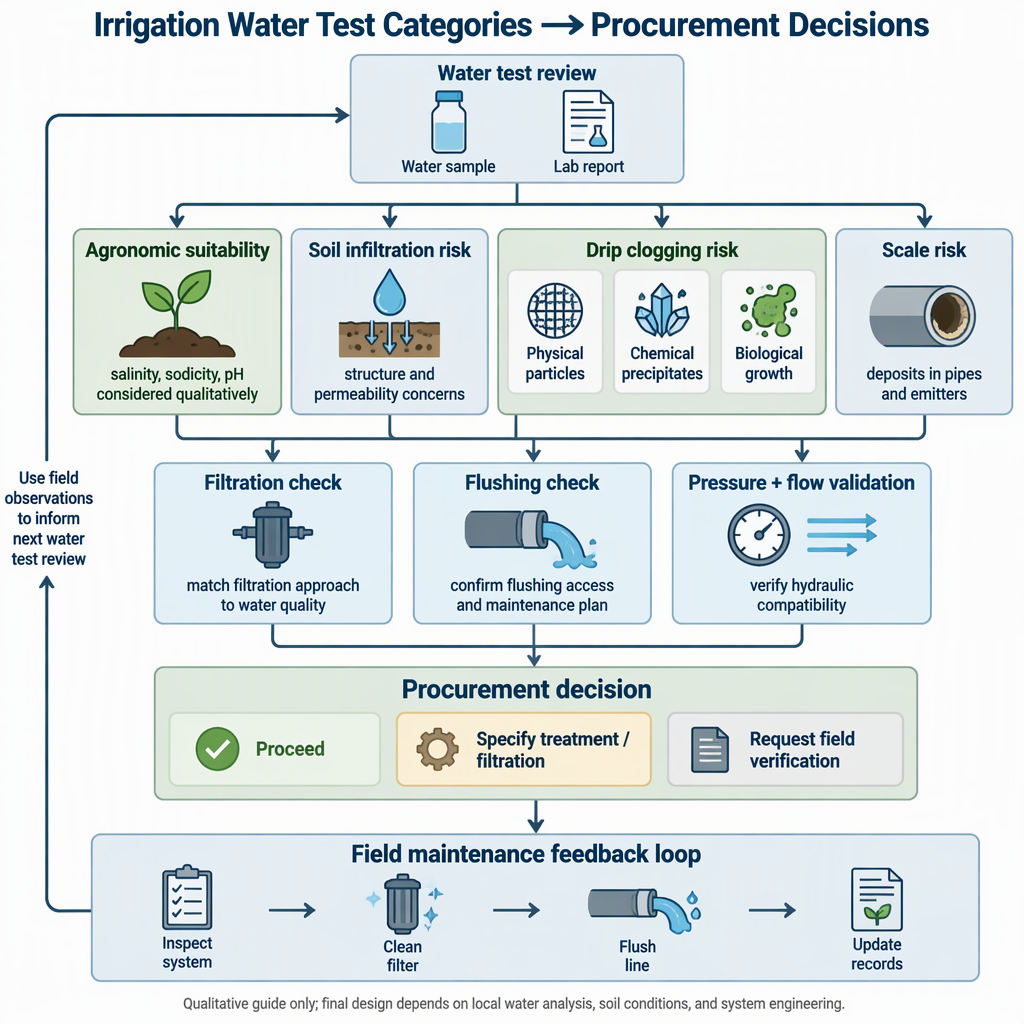
| Result category | Drip-system concern | Procurement action |
|---|---|---|
| Physical contributors | Particles and suspended materials can contribute to localized-system clogging. | Require the designer to connect water results to filter selection, flushing points, and field maintenance access. |
| Chemical contributors | Chemical conditions can contribute to clogging in localized drip irrigation. | Ask for the planned control method, monitoring point, and responsibility for treatment decisions. |
| Biological contributors | Biological growth is part of the FAO clogging-risk framework for localized drip systems. | Require an operation and maintenance plan that covers observation, flushing, and corrective escalation. |
| Scale-related indicators | High bicarbonate, calcium, or sulphate conditions can contribute to scale deposits near small openings. | Do not approve emitter, filter, and maintenance assumptions until the designer explains the scale-control basis. |
Surface-water projects need extra caution because FAO notes that surface-water quality can fluctuate during an irrigation cycle and a series of analyses may be needed.
How should the test report be judged before procurement approval?
Judge the report by restriction categories and project context, not by a single universal pass/fail number.
| If the report shows | Buyer should ask | Approval condition |
|---|---|---|
| Potential salinity restriction | Which crop, soil, leaching, and scheduling assumptions were used? | Approve only when the agronomic basis is documented for the project conditions. |
| Potential infiltration restriction | How will the soil and irrigation schedule be managed? | Require a design response before accepting the hydraulic plan. |
| Potential specific-ion toxicity | Which crop sensitivity and accumulation risks apply? | Escalate to agronomic review where crop tolerance is uncertain. |
| Abnormal pH or scale indicators | Will deposits affect emitters, filters, or maintenance intervals? | Require the designer’s treatment or maintenance rationale before purchase release. |
FAO’s water-quality evaluation framework groups irrigation-water concerns into salinity, infiltration, specific-ion toxicity, and miscellaneous problems, and treats guideline values as indicators of potential problems rather than universal suitability limits.
How should buyers separate water, equipment, and finished-system verification?
Keep the water test report separate from equipment and finished-system acceptance because the report identifies water, soil, plant, and system risks. It does not, by itself, prove that any filter, emitter, or installed system will resist clogging.
- For water verification, request the full laboratory report, sampling locations, sample dates, handling record, and interpretation memo.
- For equipment and material verification, request manufacturer documents for filters, emitters, pipes, valves, pressure regulators, and chemical-injection components that will actually be supplied.
- For design verification, require the designer to link water results to filtration, flushing, pressure regulation, flow zones, and maintenance access.
- For finished-system verification, require field records from commissioning, including pressure and flow checks at agreed locations.
- For local water-use or treated-water projects, confirm current local rules with the responsible authority before operation.
| Verification layer | Document to request | What it should answer |
|---|---|---|
| Source water | Lab report plus sample ID, location, date, collector, and handling details. | Was the tested water representative enough for design decisions? |
| Equipment and materials | Supplier data sheets and installation requirements for the selected products. | Do the selected components match the water-risk interpretation and hydraulic design? |
| Finished field system | Commissioning sheet, zone pressure readings, flow checks, filter inspection notes, and maintenance handover. | Does the installed system operate as the approved design intended? |
What field validation should follow installation?
After installation, field validation should connect the known clogging-risk categories to filter condition, flushing behavior, pressure, flow, and maintenance routines.
- Start with the approved design documents and the water-test interpretation used for procurement.
- Record operating pressure at agreed upstream, downstream, and zone-end locations while the system is running under normal conditions.
- Compare measured flow by zone with the design expectation and investigate unexplained deviations.
- Inspect filters and flushing discharge for signs consistent with physical, chemical, or biological clogging contributors.
- Where scale risk was flagged, watch for deposits near small openings and document the corrective action chosen by the responsible specialist.
- Give the operator a maintenance handover that states what to check, where to record it, and when to escalate.
- Keep pressure and flow records with the same zone names used in the design.
- Log filter inspections and flushing observations during commissioning.
- Keep water-test reports and retest records in the same project file as equipment documents.
If any manual inspection or cleaning requires access to powered pumps, controllers, fertigation equipment, or battery-powered devices, switch off and disconnect the applicable power source before manual access, then follow only the access steps allowed in the equipment manual.
When should irrigation water be retested?
Retesting should be source-dependent: surface water should be tested seasonally, shallow groundwater may need seasonal testing where conditions influence quality, and deeper wells may fluctuate less.
- Retest surface water seasonally, especially where rainfall, runoff, storage level, or source changes affect quality.
- Retest shallow groundwater when rainfall, tides, aquifer conditions, or pumping pattern changes could alter water quality.
- For deep wells, set the interval with the lab, agronomist, or project engineer instead of copying a surface-water schedule.
- Retest sooner if clogging signs appear, because localized drip systems can be affected by changing physical, chemical, or biological contributors.
Conclusion
Before approving a drip-irrigation project, require a representative water test, a handling record, an interpretation memo, equipment documents, and a finished-system validation plan.
- Sample by source and location, not by convenience.
- Specify a broad irrigation-water test menu that covers plant, soil, and system risks.
- Use restriction categories to judge suitability instead of treating one value as a universal pass or fail.
- For drip systems, make clogging risk and maintenance part of the procurement decision.
FAQs about irrigation water quality testing for drip irrigation
These questions help dealers, project engineers, and procurement teams turn irrigation water quality testing into clear project requirements.
What is the minimum useful water test panel before drip installation?
A useful panel includes pH, EC, TDS, SAR, bicarbonate, carbonate, calcium, magnesium, iron, manganese, sodium, chloride, boron, nitrate-nitrogen, and relevant nutrients or trace elements.
Is one water sample enough for a farm?
One sample may be enough only when it represents the actual source being used; if multiple wells are evaluated, collect one sample from each well.
Why does surface water need more attention?
Surface water can fluctuate during an irrigation cycle, so a series of analyses may be needed when it is used for localized drip irrigation.
Does normal pH mean the water is safe for drip irrigation?
No. FAO gives 6.5 to 8.4 as the normal irrigation-water pH range and treats abnormal pH as a warning, but pH alone does not cover salinity, infiltration, ion toxicity, or clogging risk.
Can a water test choose the filter by itself?
No. The test identifies clogging contributors, but the designer still has to connect the results to filtration, flushing, pressure, flow, and maintenance provisions.
What documents should procurement request with the lab report?
Request the sample ID, location, date, collector, container and handling protocol, shipping record, full lab results, and the interpretation used for design approval.
When should the project retest after installation?
Use source-dependent timing: surface water should be tested seasonally, shallow groundwater may need seasonal testing where conditions change, and deeper wells may need a different interval.