English


Views: 0 Author: Site Editor Publish Time: 2026-10-08 Origin: Site


Uneven water delivery represents more than just a minor nuisance in your garden or agricultural field. It directly threatens plant yield, damages landscape health, and violates strict water conservation compliance laws. Drip systems rely entirely on precise hydraulics to function correctly. When pressure fluctuates wildly, these intricate setups fail their primary purpose of uniform moisture delivery. You cannot expect optimal growth when one plant drowns while another starves.
We designed this article to provide a comprehensive diagnostic framework. You will learn exactly how to isolate the root cause of drip irrigation pressure problems without guesswork. Additionally, we offer a practical decision matrix to help you select the most reliable hardware solutions. Understanding these mechanics ensures you protect your landscaping investment and stop wasting valuable municipal water resources.
By the end of this guide, you will know how to test your system, replace faulty components, and optimize your overall watering strategy for peak efficiency.
Uneven drip irrigation flow is rarely a single-point failure; it typically stems from mismatched components, elevation changes, or bypassing pressure regulation.
Resolving low pressure in drip irrigation requires differentiating between static water pressure (system off) and dynamic water pressure (system running).
Upgrading to Pressure-Compensating (PC) emitters or resizing zones are the most scalable, permanent fixes for persistent pressure discrepancies.
Systematic troubleshooting (process of elimination) prevents wasting budget on unnecessary component replacements.
Establishing a solid baseline helps you identify when things go wrong. Optimal drip performance looks very specific. You should see a steady, uniform dripping action across all emitters on the line. Placement should not alter the output volume. Whether an emitter sits near the main valve or fifty feet away, it must deliver the exact same amount of water. We measure this output in gallons per hour (GPH). Consistent GPH signifies a healthy, well-pressurized system.
Excessive force inside your tubing creates undeniable physical evidence. You might notice blown-off micro-tubing scattered across your garden beds. Geysering emitters also indicate dangerous pressure spikes. Instead of a gentle drip, water sprays aggressively into the air. Furthermore, you might hear distinct whistling or hissing sounds at the valve manifold. These sounds occur when water forces its way through tight restrictions at velocities exceeding the system design limits. Ignoring these high-pressure indicators often leads to catastrophic mainline ruptures.
Identifying a lack of force requires closer observation. Low pressure in drip irrigation typically manifests at the furthest reaches of your layout. Emitters at the end of the line may barely weep or remain completely dry. You will likely uncover dry root zones when inspecting the soil beneath your plants. As a result, crops often show uneven stress across the same watering zone. One tomato plant might look lush and green, while its neighbor down the line appears wilted and stunted.
Ignoring these hydraulic symptoms costs serious money. You waste expensive municipal water when geysers erupt from blown fittings. This waste directly causes increased utility bills each month. Moreover, dead landscaping requires costly replacements. Mature trees and specialized crops carry immense financial value. Losing them due to poor water distribution destroys your return on investment. Proactive pressure management safeguards your budget and ensures long-term agricultural success.
Municipal and well water systems usually deliver water at 50 to 80 PSI. This massive force vastly exceeds standard drip component tolerances. Most drip tapes and micro-tubing can only handle 15 to 30 PSI safely. When you skip installing a regulator, you subject delicate plastics to intense stress. Regulators can also mechanically fail over time. Hard water scale builds up inside the housing, locking the internal spring. Diaphragm fatigue represents another common failure point. When the rubber diaphragm tears, the regulator allows full municipal pressure to flood your fragile drip lines.
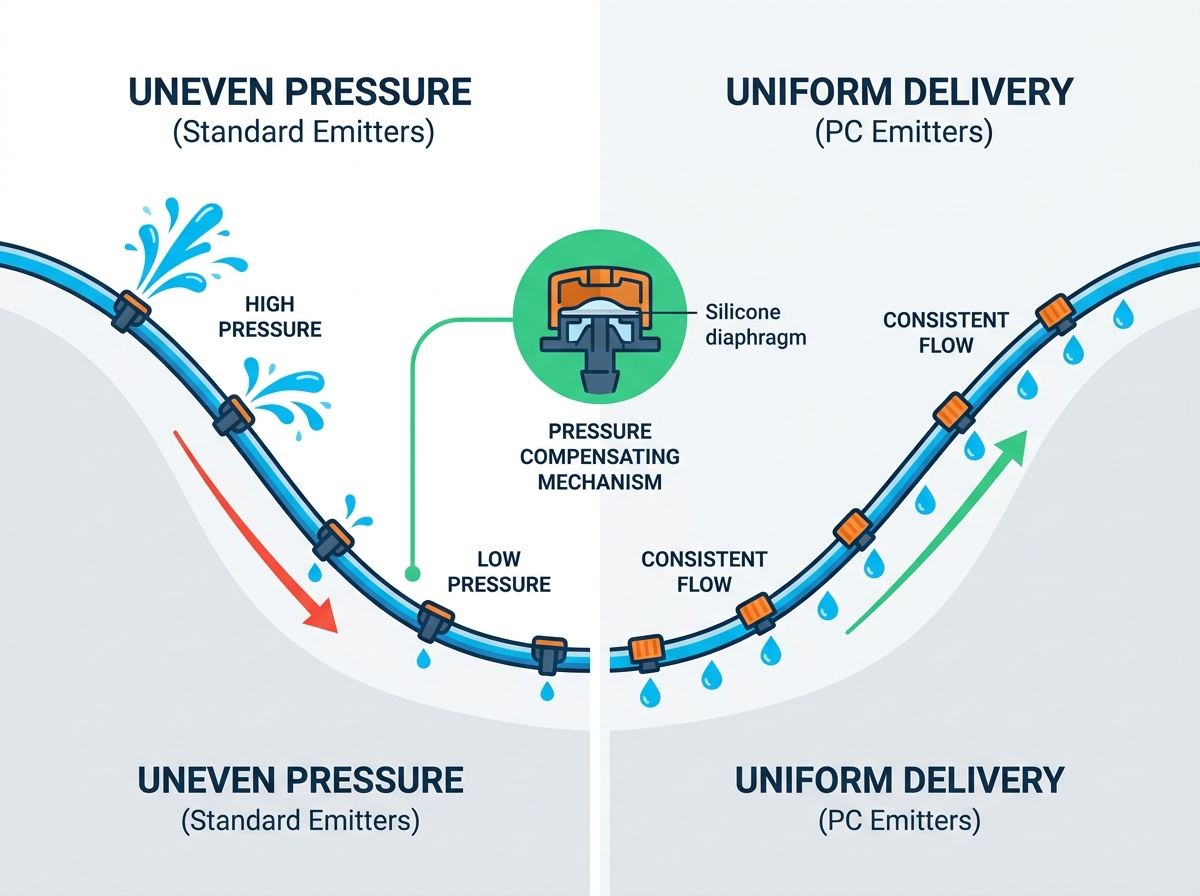
Fluid dynamics play a massive role in irrigation performance. You must account for gravity when designing your layout. Water loses roughly 0.43 PSI for every foot of elevation gain. Conversely, it gains the exact same amount when flowing downhill. If you run a drip line up a ten-foot hill, you automatically lose 4.3 PSI at the top. Sloped terrain virtually guarantees uneven drip irrigation flow if you use standard, non-compensating emitters. Gravity pulls the water downward, flooding the lowest plants while starving the plants at the crest.
Flow rates rely on strict mathematical limits. Every water source offers a maximum gallons per minute (GPM) capacity. Adding too many emitters depletes this available water volume rapidly. Running excessive lengths of mainline tubing causes a similar depletion through friction loss. As water rubs against the inside walls of the pipe, it loses energy. When you overload a zone, you create severe pressure drops at the end of the line. The water simply runs out before reaching the final plants.
Debris acts as a silent killer for irrigation efficiency. Sediment buildup in Y-filters severely restricts flow volume. Algae, sand, and mineral deposits clog the fine stainless-steel mesh. Failing solenoids in your automated zone valves also create major bottlenecks. If a valve fails to open completely, it chokes off the water supply. These restrictions directly cause downstream pressure drops. Your plants suffer simply because water cannot physically squeeze through the clogged hardware.
Guessing wastes time and money. You must approach diagnostics methodically to isolate the true hardware fault.
Baseline Gauge Testing: We strongly recommend using a liquid-filled pressure gauge. Attach a hose-thread adapter at your main water source. Record the static pressure while the system remains off. Next, turn the system on and record the dynamic pressure. Move to the end of your mainline and test the dynamic pressure again. Comparing these numbers isolates exactly where the drop occurs.
The Visual Leak Audit: Walk the entire length of your mainline while it remains fully pressurized. Look carefully for subterranean pooling in the soil. Check for blown fittings or micro-tubing disconnected from the main poly pipe. These hidden leaks siphon off crucial system pressure before the water reaches your desired plants.
Filter and Valve Inspection: Turn off the main water supply to ensure safety. Open the main filtration unit. Flush the internal screens thoroughly with clean water. Next, unscrew the tops of your zone valves. Inspect the internal rubber diaphragms for tiny tears or lodged debris. Reassemble everything tightly.
The "Cap-Off" Test: Find the midpoint of your struggling irrigation zone. Temporarily cap off the furthest half of your emitters using goof plugs. Turn the water back on. If excellent pressure immediately returns to the first half of the zone, you have found the problem. Your zone is over capacity and requires resizing.
Once you identify the root cause, you must choose a reliable fix. We created the following decision matrix to help you evaluate your options.
Hardware Fixes Decision Matrix
Solution Type | Best Use Case | Cost & Scalability | Long-Term Outcome |
|---|---|---|---|
Pressure-Compensating Emitters | Sloped terrain, long runs, fluctuating source pressure. | Moderate cost. Highly scalable across large properties. | Uniform water delivery regardless of elevation changes. |
New Pressure Regulator | System-wide blowout issues, missing baseline hardware. | Low cost. Mandatory for foundational system health. | Prevents tubing ruptures and extends component lifespan. |
Upsizing Mainlines | Friction loss problems, large agricultural setups. | High cost. Labor intensive but infinitely scalable. | Maximizes available GPM delivery to distant zones. |
Splitting Zones | Overloaded existing lines, low pressure at line ends. | Moderate cost. Requires new manifold valves. | Restores optimal PSI to all remaining emitters per zone. |
We evaluate PC emitters as the absolute best solution for sloped terrain or excessively long runs. They offer distinct advantages over standard turbulent-flow emitters. The primary benefit lies in their internal design. A small silicone diaphragm regulates the water flow perfectly. This ensures identical GPH output across varying pressures. They usually operate flawlessly between 10 and 40 PSI. However, you must accept minor trade-offs. PC emitters carry a slightly higher upfront cost. They also require a minimum pressure threshold to activate the internal diaphragm properly.
We evaluate pressure regulators as a mandatory baseline fix. You simply cannot run a reliable drip system without one. You must always install the regulator directly after the zone valve and the main filter. When selecting a new unit, carefully match the PSI rating to your specific tubing type. Use a 25 PSI regulator if you install standard drip tape. Choose a 30 PSI or 40 PSI regulator for heavy-duty poly tubing. Mismatched regulators cause immediate performance failures.
We evaluate system redesigns as strictly necessary when total emitter output exceeds your water source limits. You cannot cheat the laws of physics. If you need 20 GPM but your well only provides 10 GPM, you must adjust the layout. Consider upgrading from 1/2-inch to 3/4-inch poly tubing. Larger pipes reduce friction loss significantly. Alternatively, you can add a new manifold valve. This approach allows you to split one massive, underperforming zone into two smaller, highly efficient watering schedules.
Purchasing replacement parts introduces immediate risks if you ignore thread standards. Never mix Pipe Thread (MPT/FPT) with Hose Thread (MHT/FHT). They look similar but feature entirely different pitches and tapering. Mixing these threads when installing new pressure regulators or filters causes immediate, severe leaking. This thread mismatch guarantees catastrophic pressure loss before the water even reaches your garden beds. Always verify thread compatibility on the packaging before tightening any plastic fittings.
Many homeowners attempt quick fixes to bypass actual troubleshooting. We strongly caution against the "Band-Aid" fallacy. Do not simply turn up your main source valve to fix low pressure at the far end of a drip line. This reckless action forces dangerous amounts of pressure into the beginning of the line. You will inevitably cause catastrophic blowouts near the manifold. The pressure will rupture tubing, blow off emitters, and flood your yard. Always fix the root cause instead of increasing source force.
You must understand that no irrigation solution remains maintenance-free forever. Even the highest-quality commercial hardware requires regular attention. We recommend establishing a strict bi-annual maintenance schedule. Flush your mainlines thoroughly every spring and fall to remove accumulated silt. Inspect your PC emitters manually to ensure the diaphragms remain flexible and clean. Regular cleaning prevents unexpected failures and maintains total system integrity throughout the hottest growing seasons.
Diagnosing erratic water delivery requires methodical testing, not blind guessing. Uneven flow directly threatens your landscape investments, but the solutions are highly accessible once you isolate the root cause. You must differentiate between static and dynamic pressure to understand your hydraulic limitations fully. Avoid the temptation to implement quick fixes, as these usually cause worse damage down the road.
Your next step involves practical action. Start by purchasing a liquid-filled pressure gauge and performing a baseline test. Follow up with a thorough visual leak audit and a filter inspection before you buy any replacement parts. If you consistently struggle with sloped terrain, explore commercial-grade PC emitters for permanent stability. Should your problems persist beyond basic troubleshooting, consult a qualified irrigation specialist to evaluate your total system capacity.
A: This common issue usually happens due to friction loss or an over-capacity line. As water travels, it rubs against the inside walls of the tubing, losing energy. Furthermore, adding too many emitters depletes your available water volume rapidly. By the time water reaches the end, insufficient pressure remains.
A: We strongly advise against running any drip system without a regulator. Municipal and well water pressures regularly exceed the physical limits of drip components. Skipping the regulator risks blown fittings, split micro-tubing, and highly uneven watering across your entire landscape.
A: Test a single emitter to isolate the problem. Remove the emitter from the tubing and observe the open hole. If water sprays forcefully from the bare hole, your emitter is clogged with debris. If water barely trickles from the open tubing, your entire zone suffers from low pressure.
A: No, pressure-compensating emitters do not reduce the overall line pressure. Instead, they regulate internal flow volume. A flexible silicone diaphragm inside the emitter adjusts automatically to pressure changes. This ensures identical water output whether the line experiences 15 PSI or 40 PSI.