
English


Views: 0 Author: Site Editor Publish Time: 2026-09-09 Origin: Site


Installing an underground irrigation system feels like a permanent landscaping victory. You hide the tubes, save water, and encourage lush plant growth. But burying a drip line incorrectly carries high stakes. Place it poorly, and you face wasted water, aggressive root intrusion, and system-destroying clogs. Subsurface irrigation offers superior aesthetic and evaporative efficiency. However, it demands stricter hardware standards and maintenance protocols compared to surface-level installations.
The optimal depth relies entirely on plant root zones, soil composition, and freeze lines rather than arbitrary measurements. A shallow installation risks shovel damage, while a deep installation starves vital feeder roots. In this comprehensive guide, we preview exactly what you need to know about subsurface irrigation. You will learn standard depth guidelines by application, discover how soil types impact emitter spacing, and understand the mandatory hardware upgrades needed to prevent complete underground failure.
General Standard: Most subsurface drip lines are buried between 2 to 6 inches deep.
Turf vs. Gardens: Lawns require 4-6 inch depths to avoid aeration damage; garden beds only require 2-3 inches (or resting directly beneath top mulch).
Soil Impact: Sandy soil demands deeper placement with closer emitter spacing; clay soil requires shallower placement due to lateral water spread.
Mandatory Hardware: Burying lines without air/vacuum relief valves and check-valve emitters guarantees system failure via soil suction.
The Mulch Alternative: For many residential setups, pinning lines to the soil surface and covering them with 2 inches of mulch provides the benefits of burial without the maintenance nightmare.
Deciding between surface and subsurface installation dictates your entire project approach. Both methods deliver water efficiently, but they serve different long-term landscaping goals. You must evaluate the specific environment before digging any trenches.
Burying your tubing directly in the soil provides significant environmental controls. We see landscape architects heavily favor this method for permanent installations.
Primary advantages: It guarantees zero surface evaporation. The soil insulates the tubing, offering complete protection from UV degradation. You effectively deter surface rodents seeking water, and you eliminate tripping hazards across walkways or manicured lawns.
Implementation risks: Subsurface lines suffer from invisible leaks. A severed tube goes unnoticed until plants drown or die. You also face high susceptibility to root intrusion. Once established, the system remains difficult to modify without excavating established plant beds.
Many homeowners prefer placing tubing on top of the soil and hiding it under organic mulch. This strikes a balance between aesthetics and accessibility.
Primary advantages: You gain easy visual inspection. Finding a clog or leak takes seconds. It allows simple emitter adjustments as plants grow. Crucially, you face zero risk of vacuum-suctioning dirt directly into the emitters after watering cycles.
Implementation risks: The tubing remains highly vulnerable to accidental shovel strikes during routine weeding. Heavy rain can displace lines. Sun degradation accelerates rapidly if the topsoil or mulch washes away over time.
Always default to surface-under-mulch installations for annual vegetable gardens and frequently changing landscapes. Seasonal plants require irrigation flexibility. Conversely, reserve true soil burial for permanent turf, established orchards, and strict aesthetic commercial requirements. You want to match the permanence of the irrigation system to the permanence of the surrounding foliage.
Installation Type | Best Used For | Maintenance Level | Expected Lifespan |
|---|---|---|---|
Subsurface (2-6 inches deep) | Turfgrass, Orchards, Permanent Shrubs | High (Requires specialized hardware) | 10-15+ years |
Surface (Under 2 inches mulch) | Annuals, Vegetables, Changing Beds | Low (Easy visual checks) | 5-10 years |
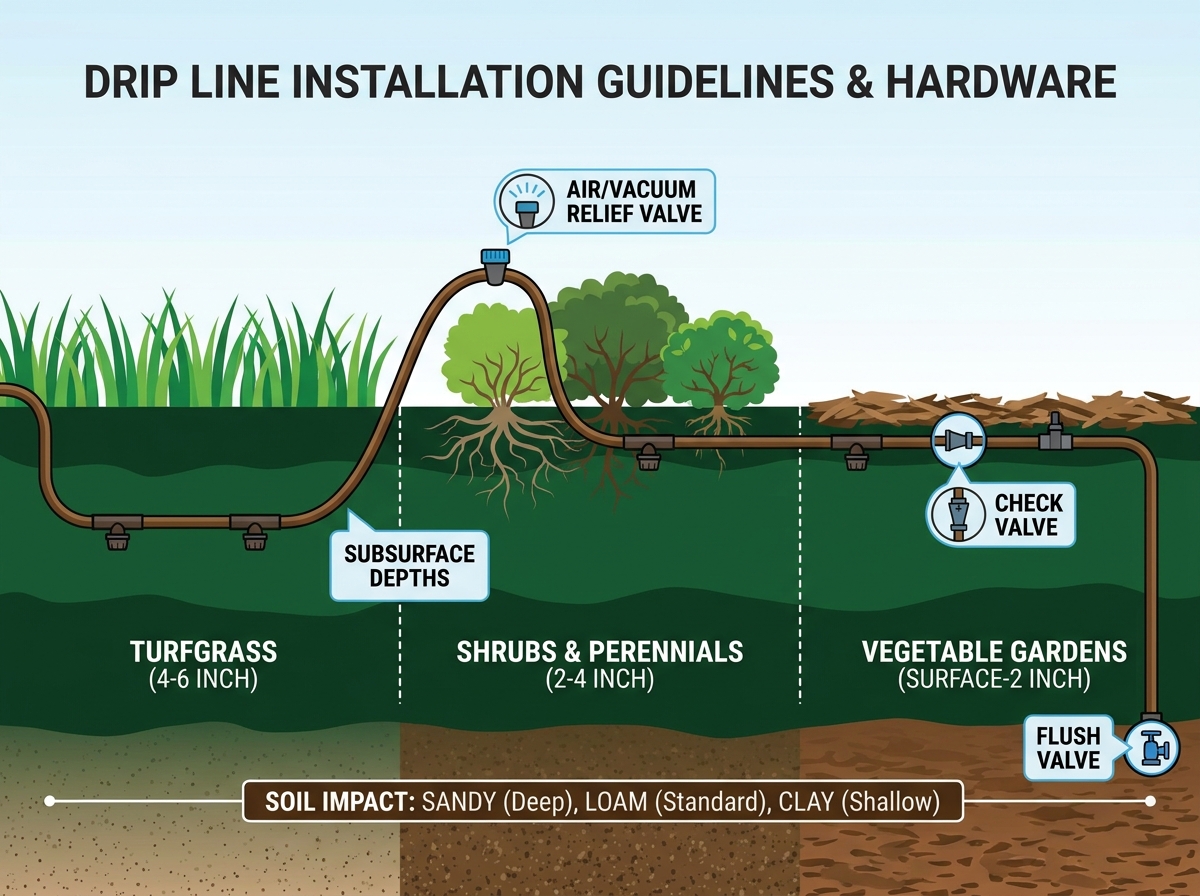
We cannot stress enough that arbitrary measurements do not work for irrigation. The correct depth depends entirely on what you are trying to grow. Below are the industry-standard depth benchmarks for various landscaping scenarios.
Subsurface turf irrigation represents the gold standard for water conservation in arid climates. However, placing the tubes too shallow guarantees disaster.
You must bury the tubing deep enough to survive routine lawn maintenance. Aeration spikes typically reach 3 inches down. Dethatching blades and heavy lawnmower traffic compress the topsoil. Placing lines at 4 to 6 inches prevents mechanical destruction.
This depth requires tight grid spacing. Installers generally use a 12x12 inch grid. This ensures overlapping moisture zones, pushing water evenly up to the grass roots through capillary action.
Permanent plant beds need consistent moisture without the risk of surface evaporation.
Place the tubing directly in the upper strata of the active root zone. Shrubs rely heavily on shallow feeder roots to absorb oxygen and nutrients.
Burying the tubing at 2 to 4 inches allows for natural downward root growth. If you bury it deeper, you risk starving these critical shallow roots during the first year of plant establishment.
Annual gardens undergo constant upheaval. Soil burial here creates unnecessary frustration.
The best approach involves laying the tubing directly on the hard dirt. Secure it with landscape staples, then cover it generously with compost or mulch.
This shallow placement accommodates seasonal tilling. You can easily roll up the irrigation grid during crop rotation without destroying a buried infrastructure.
Soil composition drastically alters how water moves underground. A perfectly installed drip line in loam will fail miserably in heavy clay. You must adjust your burial depth and emitter spacing based on regional soil types.
Sandy soils present a unique challenge because water channels straight down rapidly. Gravity easily overrides lateral capillary spread.
Behavior: Moisture forms a narrow, deep column. It rarely spreads sideways.
Adjustment: You need to bury the tubing slightly shallower. This gives plant roots adequate time to catch the falling water. Furthermore, you must utilize closer emitter spacing, typically 12 inches apart. Higher flow rates help saturate the surrounding sand before gravity pulls the water below the root zone.
Loam offers the ideal environment for subsurface irrigation. It retains moisture well while allowing excess water to drain safely.
Behavior: Water distributes evenly. It forms a perfect teardrop-shaped moisture plume beneath the soil.
Adjustment: You can strictly follow the standard 2-6 inch depth guidelines based on your specific plant type. Standard 12 to 18-inch emitter spacing works flawlessly here.
Clay soil features dense particles. It absorbs water slowly and holds it for extended periods.
Behavior: Water spreads laterally and sits just below the surface. This creates a high risk of waterlogging, which can easily suffocate plant roots.
Adjustment: You must bury the tubing at a minimum depth of 2-3 inches. Space your emitters much further apart, typically 18 to 24 inches. Always use low-flow emitters in clay. Slowing the application rate prevents surface pooling and runoff.
You cannot take standard surface tubing and bury it. Standard systems rely on atmospheric pressure to function. Putting them underground requires specific mechanical upgrades to fight soil pressure, root invasion, and back-siphoning.
This single component determines whether your system survives its first season. You must place an air/vacuum relief valve at the highest elevation point of the system.
Its function is simple but critical. When the watering cycle ends, water drains from the lowest emitters. This drainage creates a powerful vacuum at the top of the line. Without a relief valve, this vacuum sucks mud, bacteria, and debris directly into the emitters. The entire underground grid will clog permanently within weeks.
Check valves work in tandem with your relief valves. They sit within the emitters or at manifold junctions.
Their function involves keeping water trapped in the line when the system shuts off. This provides two massive benefits. First, it ensures uniform startup pressure for the next watering cycle. Second, it acts as an anti-siphon mechanism, blocking contaminated ground water from flowing backward into your main clean water supply.
Roots naturally seek out moisture sources. Standard punch-in emitters will fail underground because roots will aggressively grow directly into the water hole.
You face a strict requirement here. You must use specialized subsurface tubing. Manufacturers equip these premium lines with copper-shielded emitters. Copper naturally inhibits root cell growth upon contact. Alternative designs use chemical-treated root barriers integrated into the plastic. Never bury untreated tubing near woody shrubs or trees.
Even with perfect filtration, microscopic sediment enters your irrigation system. Over time, this sediment settles at the lowest points.
You must install flush valves at the lowest point or at the very end of your underground line. These manual or automatic valves allow you to blow out accumulated sediment at the beginning and end of the growing season. Routine flushing prevents pressure drops and prolongs the lifespan of your emitters.
Every landscaping decision carries trade-offs. Subsurface irrigation removes visual clutter, but it introduces distinct maintenance challenges. Preparing for these risks saves thousands of dollars in future landscape repairs.
When surface tubing breaks, you see a geyser of water immediately. When a buried line severs, it remains completely hidden. You will not notice the problem until surrounding plants either drown from a flooded root zone or die of thirst downstream.
We heavily emphasize the necessity of installing pressure gauges on your system manifold. Monitoring system pressure integrity gives you an early warning. A sudden drop in baseline pressure indicates a ruptured underground line long before your plants show visual signs of distress.
If you live in a climate with freezing temperatures, buried lines present a severe risk. Water left sitting in buried lines above the frost line will freeze solid. As it freezes, it expands violently, easily shattering rigid pipes and splitting flexible tubing.
You cannot rely on gravity drainage alone. Cold climates require a strict annual blowout procedure. You must use an air compressor to force all standing water out of the underground grid before the first hard freeze.
Human memory fails over time. You will forget exactly where you dug your trenches. Three years later, you might plant a new tree and slice straight through your main irrigation feed.
We champion proper mapping and documentation. Take wide-angle photos of your open trenches before you backfill them with dirt. Lay a bright measuring tape next to the trench in the photo to establish scale from a fixed point like a driveway or foundation wall. Keep these records safe to prevent future landscaping disasters. If you need professional advice on mapping complex zones, feel free to contact us for tailored guidance.
Successful subsurface irrigation ultimately boils down to a precise formula. You must calculate plant root depth, add soil capillary action, and subtract maintenance accessibility. Hitting the perfect 2 to 6-inch sweet spot ensures optimal water delivery without putting your hardware at risk.
Before you lift a single shovel, finalize your complete hardware list. Prioritize high-quality vacuum relief valves and robust, subsurface-rated tubing with root shields. Attempting to save money on standard tubing for underground use always results in premature system failure.
Take action today by evaluating your current soil type. Dig a small test hole to see how fast water drains. Then, consult a localized root-depth chart for the specific crop or turf you plan to cultivate. Armed with this data, your buried irrigation system will provide decades of invisible, highly efficient watering.
A: No. Standard thin-wall drip tape will crush under soil weight and clog immediately. Use thick-walled (16mm or 17mm) pressure-compensating tubing designed explicitly for subsurface use.
A: No. Drip lines are buried in the active root zone (2-6 inches), which is well above the frost line. They must be blown out and winterized annually in freezing climates to prevent ice expansion damage.
A: Yes, unless you use subsurface-specific tubing equipped with copper shields or root-deflecting emitter designs. You must also maintain consistent watering schedules to prevent drought-stressed roots from desperately seeking the moisture source inside the pipe.


