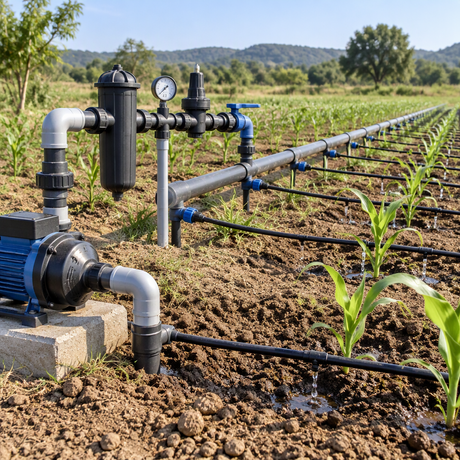
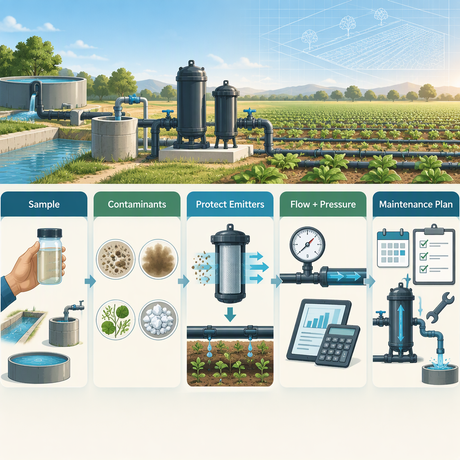
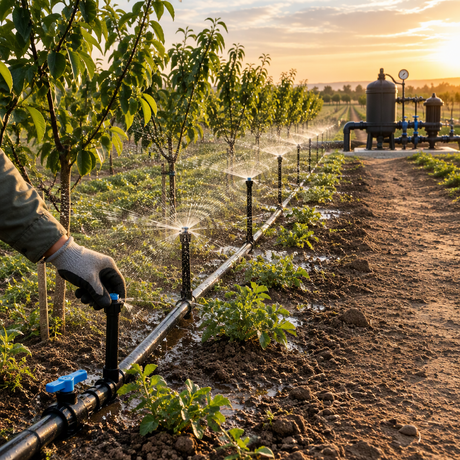
Choose a drip irrigation filter by identifying the plugging hazard first, then checking emitter sensitivity, system flow, acceptable pressure loss and the cleaning method your team can maintain. Screen filters can be a good fit for mainly inorganic particles, but surface-water projects or mixed debris often need a different or staged filtration approach.
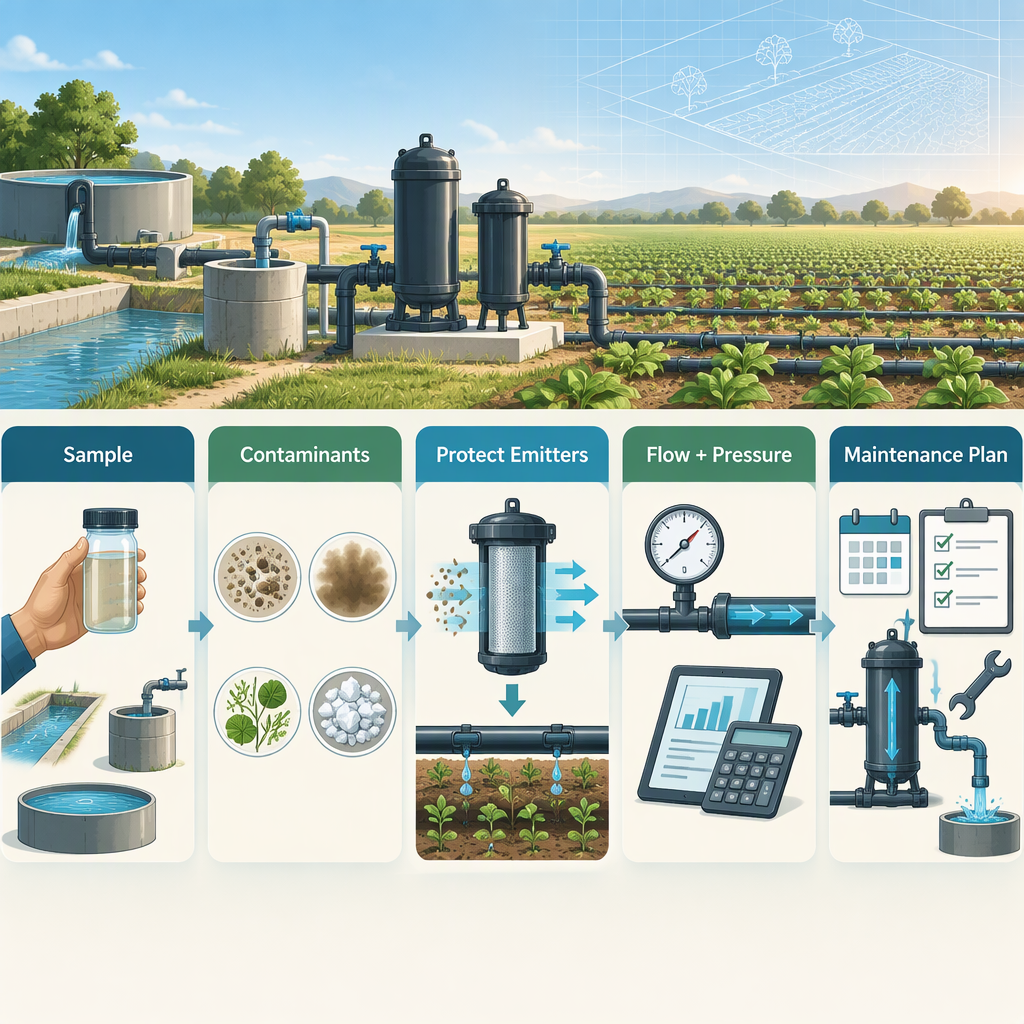
Start with the data that controls filter selection
The right shortlist starts with water quality, emitter protection needs, design flow, operating pressure range and a realistic cleaning plan, because plugging risk depends on contaminants, emitter characteristics and maintenance practice.
- Identify the water source: well, reservoir, canal, river, pond, recycled water or blended supply.
- List the likely plugging hazards: suspended sand or silt, organic debris, biological growth, chemical precipitates or a combination.
- Confirm emitter passage requirements and the filtration recommendation from the dripline or emitter supplier.
- Calculate total project flow by zone and by filter station, not only by total farm area.
- Define how the operator will clean or backflush the filter and how pressure drop will be monitored.
- For screen-filter options, match mesh selection to both contaminant size and the protection required by downstream emitters.
Match the filter to the water quality problem first
Water quality drives filter choice because micro-irrigation plugging hazards can be physical, biological or chemical, and filtration alone does not remove every cause of emitter blockage.
| Water-quality condition | Selection implication | Buyer check before RFQ |
|---|---|---|
| Mostly physical particles such as sand or silt | Screen filtration may be considered when the contaminant load is mainly inorganic and within the screen’s practical cleaning capacity. | Provide particle load, expected flow and the emitter manufacturer’s filtration requirement. |
| Organic debris, algae or surface-water material | Media filtration or staged filtration is often evaluated because organic material can overload a simple screen approach. | Share source-water analysis and seasonal changes, not only a one-time sample. |
| Chemical precipitation or biological growth risk | Filtration should be paired with treatment, flushing and maintenance planning where water analysis shows those risks. | Ask the designer to separate filtration, water treatment and field flushing responsibilities. |
A water test is more useful than a generic mesh number. Use current water analysis and operating conditions to define the problem, then select the filter configuration around that problem. For a technical background on plugging hazard categories, see the Virginia Cooperative Extension discussion of micro-irrigation filtration and maintenance.
Compare screen, disc, media and separator roles
Filter types should be compared by contaminant type, flow capacity, pressure-loss tolerance and cleaning method rather than by assuming one technology is best for every drip system.
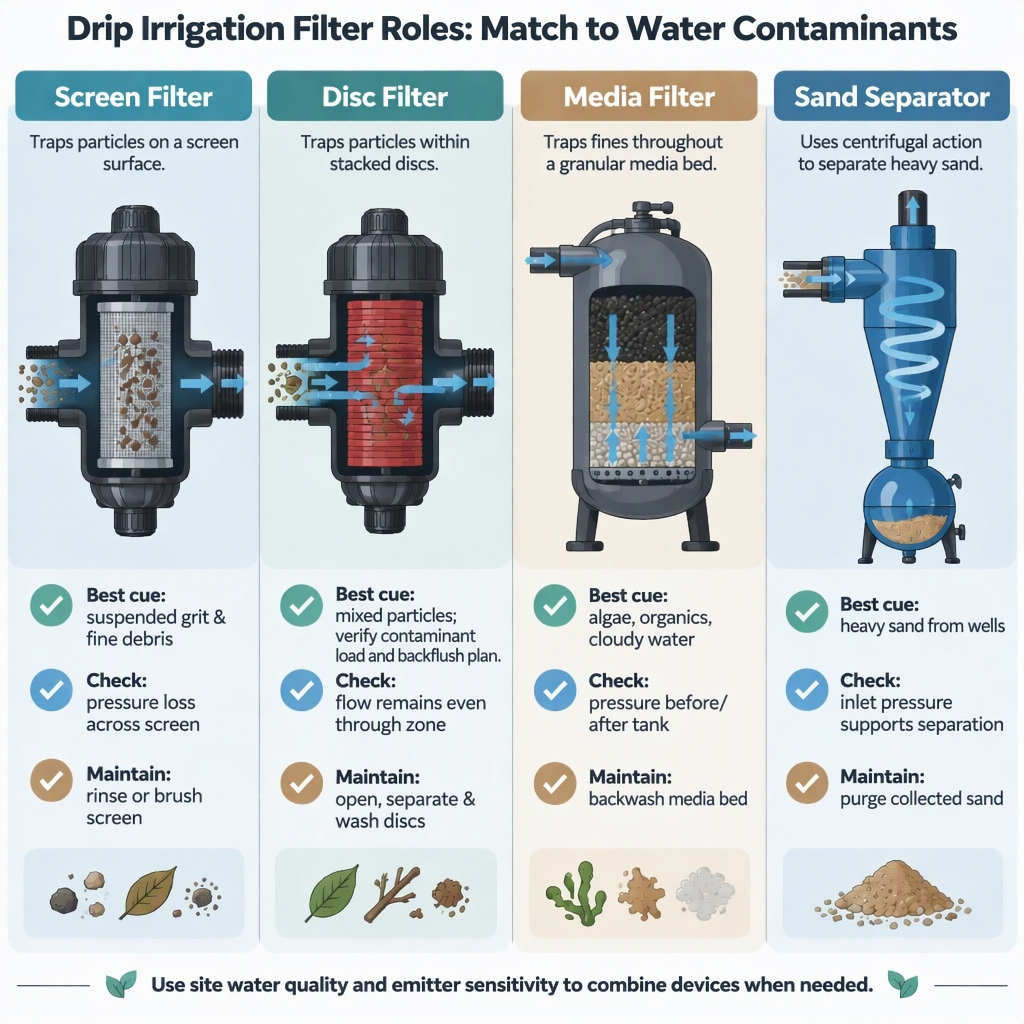
| Option | Best-fit role | Important limit | Procurement question |
|---|---|---|---|
| Screen filter | Mainly inorganic contaminants such as fine sand or scale when the loading is manageable. | It can require frequent cleaning if surface-water organic load is high. | What mesh options, clean pressure loss and cleaning method match the emitter requirement? |
| Disc filter | Projects that need filtration through grooved discs and a cleaning/backflush plan suited to the water load. | Disc selection still depends on contaminant type, flow and maintenance practice. | What flow range and backflush conditions apply to the proposed disc-filter model? |
| Media or sand-media filter | Surface-water or organic-load applications where depth filtration may be needed ahead of finer protection. | Media systems require backwash planning and pressure monitoring. | What backwash flow, pressure and water-disposal arrangement does the station require? |
| Sand separator or pre-separation step | High sand load situations where coarse separation can reduce burden on downstream fine filtration. | It is normally not a complete substitute for final emitter-protection filtration. | Is the separator upstream of a screen, disc or media filter in the proposed layout? |
For screen filters specifically, the University of Florida IFAS publication on screen filters in drip irrigation systems notes their role with inorganic contaminants and their frequent use as secondary filtration after media filtration for surface-water systems.
Size the shortlist around flow and pressure drop
A filter that matches the contaminant but cannot handle the design flow or pressure-loss limits will become a bottleneck, so sizing must use zone flow, station flow and cleaning-trigger pressure drop.
- Calculate maximum simultaneous flow through the filter station, including any flushing or backflush requirement if the system design uses automatic cleaning.
- Compare the required flow with the allowable flow-rate range for the filter type and model proposed by the supplier.
- Set a clean-filter pressure baseline during commissioning so operators can recognize when pressure drop indicates cleaning is needed.
- Check that the pump and control-valve arrangement can maintain downstream pressure after normal filter loss and during cleaning cycles.
- For screen filters, confirm that mesh selection, screen area and cleaning method are compatible with the contaminant load and planned flow.
Do not size only by pipe diameter. Two stations with the same pipe size can have different emitter protection needs, flow peaks, contaminant loads and cleaning intervals.
Plan cleaning and maintenance before purchase
Filter maintenance should be planned before purchase because plugging prevention depends on monitoring, cleaning response and system flushing, not only on the filter body installed at the headworks.
- Specify whether cleaning will be manual, semi-automatic or automatic backflush.
- Include pressure gauges or other pressure-difference monitoring points so operators can react to pressure-drop changes.
- Plan field flushing and water-treatment responsibilities when water analysis indicates biological or chemical plugging risks.
- If using a screen filter, confirm how the screen will be cleaned and how often inspection is expected under the project’s water conditions.
- Keep spare wear items and cleaning tools consistent with the manufacturer’s current manual.
- Record clean operating pressure after installation.
- Monitor pressure drop during irrigation and clean when the system reaches the manufacturer’s or designer’s trigger point.
- Before opening any filter housing, screen chamber or disc stack, stop the pump, disconnect the applicable electrical power or battery source, isolate the filter from line pressure and relieve pressure according to the model manual.
- Use only the access, cleaning and reassembly steps allowed by the filter manufacturer; do not bypass guards, controls or backflush interlocks.
Prepare an RFQ package that separates needs from assumptions
A useful RFQ gives the supplier water-quality data, flow and pressure conditions, emitter requirements and maintenance expectations so the proposal can be checked against the actual field problem.
- Water source, water analysis and seasonal variation notes.
- Emitter or dripline filtration requirement from the irrigation design or emitter supplier.
- Design flow by station, maximum simultaneous zone flow and expected operating pressure.
- Available power, control preference and whether automatic backflush is required.
- Maintenance staffing, expected inspection access and pressure-monitoring method.
- Required product category, such as drip irrigation equipment, sprinkler irrigation equipment, fertigation equipment, water-control valves or filtration products.
The supplier presents irrigation product categories that include drip irrigation, sprinkler irrigation, fertigation equipment, water-control valves, filters and related accessories.
Its filter-related categories include automatic backwash disc filters, automatic backwash sand or media filters, T-type disc or screen filters, ordinary disc filter systems and manual screen filters.
For procurement, treat those categories as a starting point and request model-level rated flow, pressure range, mesh or filtration grade, backflush requirements and installation drawings for the specific project.
Conclusion
The practical choice is the filter station that matches the water hazard, protects the emitter, carries the design flow and can be cleaned reliably under field conditions.
- Test the water before choosing the filter type.
- Check flow and pressure drop before accepting a quotation.
- Use screen filters where their inorganic-particle role and cleaning burden fit the project.
- Plan maintenance, flushing and treatment for biological or chemical risks instead of expecting filtration alone to solve them.
FAQs about drip irrigation filter selection
Most buyer questions come back to the same decision points: contaminant type, emitter protection, flow, pressure loss and maintenance capacity.
Is a 200-mesh filter always enough for drip irrigation?
No. Mesh must be matched to emitter requirements and the actual contaminant load; a generic mesh number is not a complete selection method.
Can filtration alone solve chemical or biological clogging?
No. Chemical precipitation and biological growth can require water treatment, flushing and maintenance planning in addition to filtration.
Can a screen filter be used with surface water?
Sometimes, but UF IFAS notes that screen filters are often used as secondary filters after media filtration in surface-water applications, especially where organic material is present.
Why does pressure drop matter in filter selection?
Pressure drop shows how much resistance the filter adds and can indicate when cleaning is needed; it also affects whether downstream emitters receive the pressure they require.
When should media filtration be considered?
Media filtration is commonly evaluated where surface water or organic loading makes depth filtration and planned backwashing more suitable than relying on a simple screen alone.
What data should be sent before requesting a quotation?
Send water analysis, water source, emitter filtration requirement, design flow, operating pressure range, cleaning preference and any backflush-control requirements.