English


Views: 0 Author: Site Editor Publish Time: 2026-08-14 Origin: Site


Running a drip line is never a simple guessing game. It requires a precise calculation. You must carefully balance plant water requirements, soil absorption, and hardware output. You need exactly the right amount of moisture to thrive.
Under-watering causes severe plant stress and immediate yield loss. Conversely, over-watering wastes valuable resources. It drastically increases disease risk and damages delicate soil structure over time. Neither extreme supports healthy crop growth. You must manage your watering strategy proactively to protect your plants.
We will show you how to find the ideal watering duration. You will learn to match your emitter's Gallons Per Hour (GPH) flow rate with specific soil types. The ideal duration also depends on seasonal Evapotranspiration (ET) rates. We also cover how smart irrigation controllers help manage these complex variables easily.
Standard drip line run times typically range from 30 to 90 minutes, but this baseline must be adjusted based on emitter flow rates (GPH).
Soil type dictates irrigation frequency and duration: sandy soil requires shorter, more frequent watering, while clay requires longer, less frequent sessions to prevent runoff.
Relying on manual operation is error-prone; upgrading to a smart irrigation controller allows for automated adjustments based on real-time weather and ET data.
The "trowel test" remains the most reliable, evidence-based method to physically verify that your calculated run time is achieving the correct moisture depth.
Selecting the right hardware defines your baseline run time. Your emitters control exactly how fast water leaves the system. You cannot determine a watering duration without knowing this output first. Everything starts with understanding your specific flow rates.
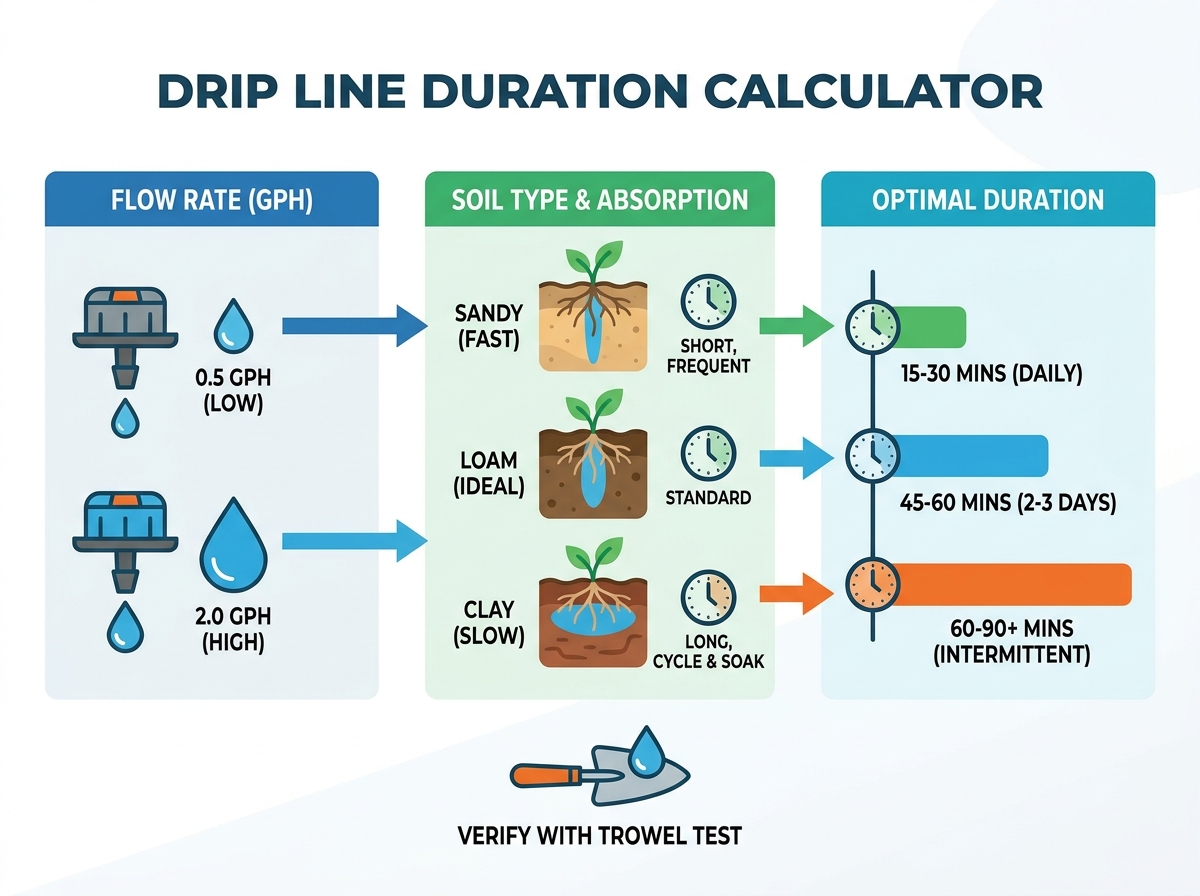
You must evaluate your hardware carefully to ensure desired outcomes. Compare low-flow emitters with high-flow alternatives. A low-flow emitter might deliver 0.5 GPH. A high-flow emitter might output 2.0 GPH or more. This difference fundamentally changes your watering schedule.
A 0.5 GPH emitter requires four times the run duration of a 2.0 GPH emitter. They both deliver the exact same volume of water eventually. If your plant needs two gallons of water, the 2.0 GPH emitter finishes in one hour. The 0.5 GPH emitter takes four hours to finish.
We must establish a scientific baseline to guarantee watering accuracy. You need to understand Evapotranspiration (ET). ET represents the total moisture lost through soil evaporation and plant transpiration. You must replace this lost moisture consistently to prevent plant stress.
You can calculate total weekly run hours using a simple formula. First, determine the total gallons required per plant per week based on ET data. Next, divide this weekly requirement by your emitter's output rate. The resulting number dictates your total weekly run hours.
For example, a mature tomato plant might require four gallons weekly during peak summer. If you use a single 1.0 GPH emitter, you need four hours of total watering time per week. You will then divide these four hours into multiple sessions based on your soil profile.
However, you face severe implementation risks if you design the system poorly. Mixing different GPH emitters on the same unzoned line is a critical mistake. It leads to severe watering disparities across your garden. You cannot control individual run times on a single zone.
If you place a 2.0 GPH emitter and a 0.5 GPH emitter on the same tube, problems arise. Running the system for one hour gives one plant two gallons. The other plant receives only half a gallon. One plant drowns in mud while the other suffers from severe drought stress.
You must group similar emitters onto their own dedicated zones. Keep all 0.5 GPH emitters on one valve. Keep 2.0 GPH emitters on a separate valve. This separation gives you complete control over your specific watering durations.
Hardware output must always be evaluated against environmental constraints. Your emitters might dispense water flawlessly. However, your soil might reject that water completely. You must understand your ground conditions before setting a timer.
Water applied faster than soil can absorb leads to immediate pooling. This pooling eventually turns into destructive runoff. Runoff washes away valuable nutrients and erodes your topsoil. It renders your careful GPH calculations entirely useless.
You must evaluate your specific soil type to determine safe run times. Soil texture dictates both infiltration rate and moisture retention. Let us examine the three primary soil categories and their watering rules.
Clay soils present unique irrigation challenges. They possess exceptionally low infiltration rates. The dense microscopic particles pack tightly together. Water struggles to penetrate this hard barrier quickly. Therefore, continuous long watering sessions fail on clay.
Clay requires strict "cycle and soak" methods to prevent runoff. You must break your total run time into smaller segments. Instead of running one continuous 60-minute session, split it up. Run three 20-minute sessions with an hour break between each. This resting period allows water to percolate deeply.
Sandy soils behave entirely differently. They feature high infiltration rates but very low moisture retention. Large particles allow water to drop straight down via gravity. Water moves through sand rapidly and escapes the root zone quickly.
Sandy profiles require shorter, much more frequent watering runs. You might need to water for 15 to 30 minutes every single day. This frequent scheduling prevents water from pushing past the active root zone. It keeps the shallow soil consistently moist for your plants.
Loam soils offer the ideal environment for irrigation. They possess excellent moisture retention and moderate infiltration rates. Loam absorbs water readily without immediate pooling. It also holds that moisture well over time.
Loam supports standard uninterrupted run times easily. You can typically run your system for 45 to 60 minutes continuously. The water spreads out evenly in a desirable horizontal pattern beneath the surface.
Soil Type | Infiltration Rate | Moisture Retention | Recommended Watering Strategy | Typical Session Duration |
|---|---|---|---|---|
Clay | Very Low | High | Cycle and Soak | 15 - 20 minutes (multiple times) |
Sand | High | Low | Short, Frequent Sessions | 15 - 30 minutes (daily) |
Loam | Moderate | Ideal | Standard Uninterrupted | 45 - 60+ minutes |
We must acknowledge transparent assumptions regarding these guidelines. These standard timelines assume flat ground and well-tilled earth. Compacted soil or steep gradients will drastically alter these standard absorption timelines.
If you garden on a steep hill, runoff happens much faster. You will need to implement aggressive cycle and soak strategies even on loam. Highly compacted urban soils often mimic clay behavior initially. You must always observe your soil's physical reaction to the watering process.
Manually turning a system on and off is unsustainable. It requires your physical presence every single day. This approach scales poorly as seasons change and weather fluctuates. You will eventually forget to turn a valve off.
You need a reliable controller to manage these precise durations automatically. The market offers two primary solution categories. You must choose between basic digital timers and advanced smart systems. Each option serves a different operational need.
Mechanical and basic digital timers are highly cost-effective. They run on simple AA batteries and attach directly to your hose bib. You program a start time and a run duration. The machine executes this exact schedule flawlessly every day.
These basic timers are good for static greenhouse setups. Greenhouses maintain consistent temperatures and block natural rainfall. The plants experience identical conditions daily. However, basic timers require manual reprogramming whenever seasonal weather changes occur.
Smart Wi-Fi controllers represent a significant technological upgrade. They carry a higher upfront cost than basic timers. However, they actively mitigate the severe risk of overwatering. They do this by integrating live local weather data into their daily schedules.
A smart system downloads ET formulas and solar radiation data nightly. If a rainstorm approaches, the controller skips the scheduled watering automatically. If a sudden heatwave hits, it increases the run duration to compensate. They adjust run times automatically without your intervention.
Your shortlisting logic should rely on a few key factors. Base your purchase decision on your zone requirements and overall budget. You must also verify the availability of a strong local Wi-Fi signal near your controller box.
If you manage multiple distinct hydro-zones, a smart controller is mandatory. It allows you to program unique ET rates for your vegetable beds versus your drought-tolerant shrubs. We emphasize that smart controllers yield a higher long-term ROI. They achieve this primarily through aggressive water conservation and improved crop health.
Proper controller setup ensures your calculated durations execute perfectly. If you require assistance selecting the correct automated valves for your property, please contact us directly. We can help you design a responsive, automated watering schedule.
You must never rely entirely on algorithms or manufacturer specifications. Theoretical math provides an excellent starting point. However, actual soil dynamics differ wildly from controlled lab conditions. You need physical proof that your system works.
Rocks, varying organic matter, and underground hardpans alter water flow. Water rarely behaves exactly as a spreadsheet predicts. You must verify moisture penetration manually to protect your root systems.
We highly recommend the classic trowel test protocol. It remains the most accurate way to visualize your watering effectiveness. It costs nothing and provides immediate, actionable evidence.
Follow these steps to perform a proper trowel test:
Run the system for your precisely calculated duration.
Turn the system off completely once the cycle finishes.
Wait 1 to 2 hours for the water to percolate downward.
Take a small garden trowel and dig near a representative plant.
Dig down 6 to 12 inches to verify actual moisture penetration visually.
Waiting an hour before digging is absolutely critical. Water moves via capillary action horizontally and gravity vertically. It takes time for moisture to settle into its final position. Digging immediately after watering gives you a false reading.
You must dig carefully to avoid severing delicate feeder roots. Once you reach the appropriate depth, feel the dirt. The soil should feel like a wrung-out sponge. It should not feel like dry dust or dripping wet mud.
The results of this test dictate your system tuning strategy. If the water remains too shallow, you must increase your run time. Shallow watering encourages weak surface roots that dry out quickly during heatwaves.
Conversely, check if the soil is completely saturated past the root zone. If you find mud 18 inches down, you are wasting water. You must decrease your run time immediately. Alternatively, you can reduce your emitter GPH to apply water more slowly.
Scalability ensures your plants survive year-round weather shifts. A summer run time will absolutely drown your plants in the early spring. You must adapt your schedules to match shifting seasonal demands.
Spring temperatures remain cool. Plant canopies remain relatively small, meaning transpiration stays low. Your early season run times should reflect this reduced water demand. Overwatering in spring suffocates cold roots and promotes fungal diseases.
We must use a strategic decision-stage adjustment framework for summer. You need to know how to scale operations during peak summer heat. Simply doubling your run duration is often the wrong approach.
During extreme heat, focus on increasing watering frequency rather than just duration. Extending a one-hour run to two hours often pushes water deeply past the roots. The plant cannot access that deep water. Instead, run the normal one-hour cycle twice a day to maintain optimal root moisture.
You must adapt to plant growth as the season progresses. A small seedling needs one emitter placed directly near its stem. A mature bush needs a wide ring of moisture to support its massive root network.
Highlight the importance of adding localized shut-off valves to your lines. You should also plan on modifying emitter counts proactively. As plants mature and their canopy grows, their water requirements multiply rapidly. Add extra emitters around the expanding drip line of the plant.
You must also factor in compliance and municipal standards. Local water restriction compliances dictate when you can legally run irrigation. Many cities restrict outdoor watering to two specific days per week during droughts.
You must ensure your chosen hardware aligns with municipal drought guidelines. If you can only water twice a week, you might need higher GPH emitters. You must deliver the required weekly volume within a compressed, legally allowed time window. Proper planning prevents fines and keeps plants alive during restrictions.
The correct watering duration requires more than just turning a valve. It represents a precise intersection of hardware specifications, specific soil types, and verified field testing. You must calculate your emitter output against your plant's weekly ET requirements to establish a solid baseline.
Adjusting for sandy or clay soil prevents wasteful runoff and dangerous root rot. Automated controllers remove the daily burden of manual operation while protecting your crops from sudden weather shifts. Finally, physical verification grounds your calculations in reality.
Take immediate action to optimize your setup today. First, audit your current emitters to confirm their actual GPH ratings. Next, run a cycle and perform a trowel test to establish a factual moisture baseline. Finally, evaluate whether upgrading to a smart Wi-Fi irrigation controller is the right move to automate your seasonal adjustments seamlessly.
A: It depends heavily on your soil type and plant maturity. Sandy soils dry out rapidly and often require daily watering. Loam or clay soils retain moisture much longer, favoring every-other-day schedules. Watering less frequently but deeply encourages deep root growth, making plants far more resilient against extreme drought conditions.
A: Vegetable gardens possess shallow root zones requiring frequent, shorter runs to keep the topsoil consistently moist. Fruit trees feature deep, expansive root systems. They require extensive, deep watering sessions lasting several hours, applied much less frequently. You must put vegetables and trees on completely separate watering zones.
A: Watering overnight minimizes evaporation losses beautifully. However, it can leave surface soil damp for extended periods in cooler climates, increasing fungal disease risks. Evidence-based horticultural best practices usually recommend watering in the early morning. This timing reduces evaporation while allowing the soil surface to dry during the afternoon sun.
A: You can verify output using the catch-cup testing method. Place a measuring cup under an active emitter and run the system for exactly 15 minutes. Measure the captured water volume in ounces. Multiply that volume by four to determine hourly output, then convert ounces to gallons to verify the GPH rating.