
English


Views: 0 Author: Site Editor Publish Time: 2026-06-19 Origin: Site


Modern farming operations require massive capital investments for agricultural irrigation. Growers often struggle daily balancing low initial prices against recurring replacement expenses. You will find vastly conflicting industry information regarding system durability. Some suppliers treat these irrigation materials as single-season disposables. Others claim multi-decade lifespans under ideal conditions. This discrepancy makes accurate financial planning incredibly difficult for commercial farms. We will provide a transparent evaluation framework to guide your next purchase. You will learn how to calculate system longevity in the field accurately. We will also help you select the exact durability grade required for your specific crop cycles. Understanding these variables prevents expensive mid-season failures.
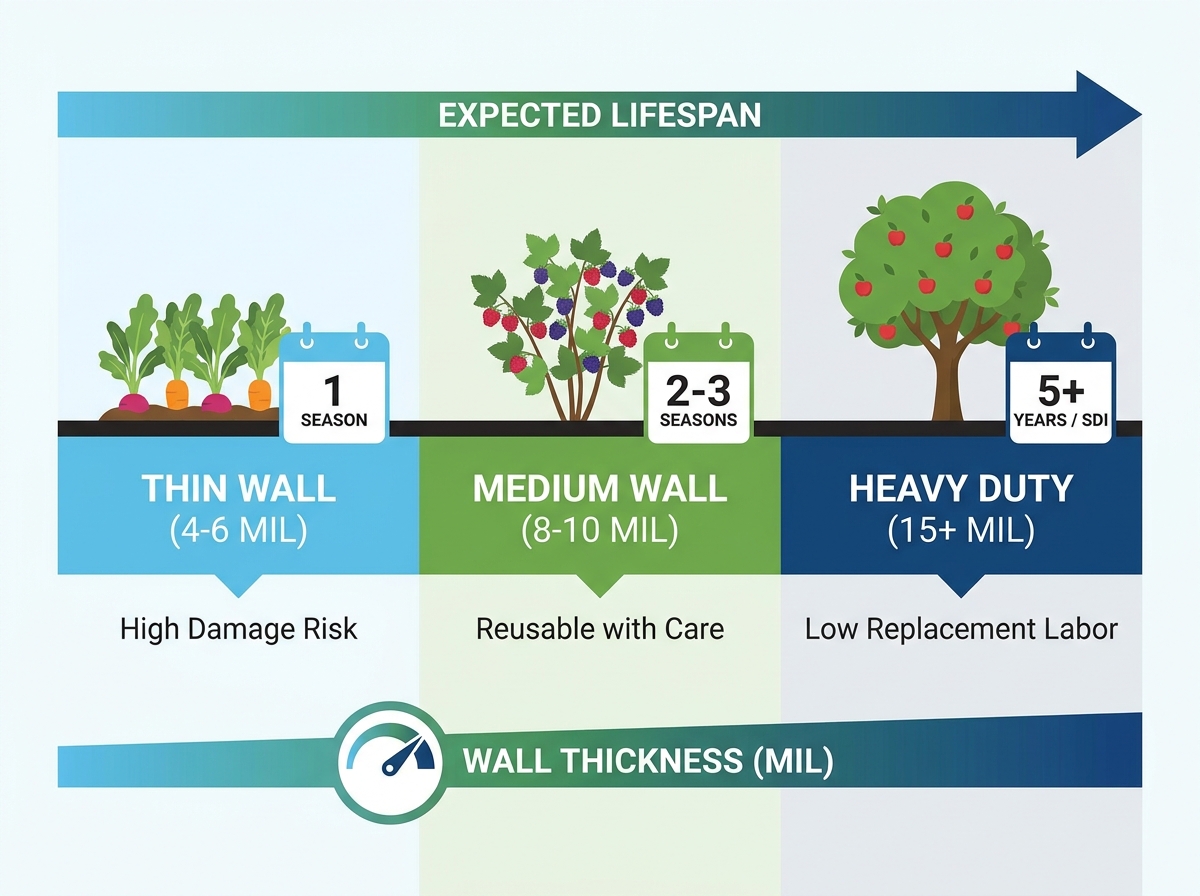
Baseline longevity is primarily dictated by wall thickness (mil rating), ranging from a single season for thin wall drip tape to 5+ years for heavier gauges.
Water filtration quality and pressure regulation are the two biggest operational predictors of premature failure.
Multi-year lifespan claims (10–20 years) require strict conditions: subsurface installation (SDI), heavy mil ratings (15+), and aggressive pest management.
Matching tape lifespan to the crop cycle (e.g., seasonal vegetables vs. permanent orchards) yields the highest commercial ROI.
Thickness serves as the foundational metric for evaluating durability. Manufacturers measure this thickness in "mils". One mil equals one-thousandth of an inch. A higher mil rating directly correlates to better puncture resistance. It also determines how well the material withstands stretching during installation. You must match this specification to your specific field requirements.
You should typically rely on thin wall drip tape for seasonal row crops. These thin gauges work perfectly for quick crop cycles. However, they remain highly susceptible to insect damage. Field stretching easily alters their emitter flow rates.
Consider this option strictly for single-harvest use. Retrieval for reuse rarely makes financial sense. You will experience high breakage rates during end-of-season removal. The labor cost to patch micro-tears usually exceeds the price of buying new rolls.
The 8-mil to 10-mil range represents the industry standard. It serves as the baseline for general agricultural drip tape applications. You can often make these lines last two or three seasons. Achieving this requires careful retrieval and proper storage.
This category balances material costs efficiently. It offers modest reusability for mid-sized farming operations. You must flush the lines thoroughly before winter storage. Proper spooling prevents severe kinking and structural weakening.
Manufacturers design heavy-duty options for multi-year surface use. They also use 15+ mil specifications for Subsurface Drip Irrigation (SDI). These robust lines resist harsh environmental stressors effectively.
You will face higher capital expenditure initially. However, thicker lines dramatically lower year-over-year replacement labor. You can leave them in place for permanent crop setups. They endure moderate mechanical impacts much better than lighter gauges.
Wall Thickness Performance Matrix
Mil Rating | Typical Lifespan | Best Application | Reusability |
|---|---|---|---|
4 - 6 Mil | 1 Season | Seasonal Row Crops | Very Low |
8 - 10 Mil | 2 - 3 Seasons | Market Gardens | Moderate |
15+ Mil | 5+ Years | Orchards & SDI | High |
Wall thickness only tells part of the story. Environmental and operational variables heavily influence actual field lifespans. Managing these five factors prevents catastrophic mid-season irrigation failures.
Internal failure ruins lines faster than external wear. Clogged emitters stop water distribution entirely. You must maintain strict water quality standards. We recommend using 150-mesh to 200-mesh filters minimum.
Algae and suspended solids build up inside the pathways. Iron bacteria can completely cement the emitter labyrinths. Once an emitter clogs permanently, you cannot repair it. Consistent chemical flushing keeps the internal pathways clean and functional.
System pressure directly dictates structural integrity. Spikes cause blowouts easily in standard flat drip tape. Most thin lines require pressure between 8 and 15 PSI. Exceeding these limits stretches the polyethylene matrix.
You must install high-quality pressure regulators. Placed at every header, these devices prevent surges. Surges often occur during pump start-ups. A single pressure spike can split hundreds of feet of plastic instantly.
Animals view irrigation lines as free water sources. Coyotes, mice, and birds frequently chew through thin plastics. Wireworms also puncture lines hidden under mulch. Arid climates intensify this specific field risk.
You should implement aggressive pest management strategies. Leaving shallow puddles away from the crops sometimes distracts larger animals. Some growers bury lines slightly to hide them from birds. You must patrol fields regularly to patch rodent bites quickly.
Ultraviolet radiation breaks down plastics over time. Sun exposure makes the material brittle and fragile. Lines laid on the surface experience rapid UV degradation. Dark plastics absorb heat, accelerating this chemical breakdown.
Shallow burial protects the material from direct sunlight. Full Subsurface Drip Irrigation eliminates UV exposure entirely. If you farm on the surface, canopy cover helps shield the lines. Always store unused rolls in completely dark barns.
End-of-season retrieval heavily impacts multi-year viability. Dragging lines across abrasive soil causes severe micro-tears. Tractor-mounted spoolers sometimes pull the plastic too tightly. Stretching permanently alters the precision emitter flow rates.
Manual retrieval increases labor costs significantly. You must weigh this labor against the price of buying new materials. If you choose to store them, flush every line with acid first. Drain all remaining water to prevent winter freeze expansion.
You will often encounter bold marketing claims regarding longevity. Some suppliers advertise lifespans exceeding twenty years. You should approach these high-end industry claims skeptically. Standard surface installations will never achieve this duration.
Achieving multi-decade durability requires incredibly stringent parameters. You must engineer Deep Subsurface Drip Irrigation (SDI) applications. Installers bury these systems several inches below the plow zone. They remain undisturbed by tractors and surface weather variations.
You must use heavy mil thickness for these permanent setups. Manufacturers recommend 15 mil minimums for SDI. Often, they suggest specs closer to rigid drip line standards. Impeccable acid-wash maintenance becomes absolutely mandatory. You must program automated flush cycles to prevent root intrusion.
We advise buyers to remain transparent about field capabilities. Do not model your farm operations on a 20-year lifespan assumption. You should only expect this if fully committing to an engineered SDI system. Standard vegetable farming will never see these maximum longevity metrics.
Connecting product specifications to commercial growing scenarios simplifies purchasing. Every farm operates under different capital constraints. You must match the material grade to your exact harvesting strategy. Over-engineering wastes money, while under-engineering causes crop failures.
Market gardeners constantly rotate crop varieties. Frequent field tilling requires removing irrigation hardware seasonally. The 8-mil category serves as the ideal sweet spot here. It offers excellent seasonal flexibility and strict cost control.
You avoid the premium pricing of heavy-duty lines. Yet, you gain enough durability to survive basic field handling. If harvest schedules allow, you can carefully spool it for a second year. This flexibility maximizes your seasonal capital efficiency.
Orchards require long-term infrastructure stability. Trees and vines live for decades in the exact same location. Investing in heavier 15-mil tape prevents catastrophic yield losses. Unexpected underground leaks can drown expensive root systems quickly.
Many vineyard managers eventually transition to rigid drip lines. However, heavy-duty flat options provide a reliable intermediate step. They withstand the occasional mechanical strike from harvesting equipment. You secure peace of mind during crucial summer drought periods. Reach out to a drip tape specialist today to confirm your orchard's requirements.
Even the highest quality materials fail under poor management. Installation errors account for a massive percentage of early blowouts. Stretching the plastic while laying it creates invisible weak points. This stretching alters the internal emitter flow rates permanently. The wall becomes too thin to handle standard operating pressures.
Improper fittings create frustrating headaches for field crews. Using the wrong connectors leads to severe leaks at the headers. Barbed fittings meant for thicker hoses will crack thin walls. You must utilize specialized tape-loc fittings. They compress the plastic evenly without causing micro-fractures.
Inadequate winterization destroys reusable lines overnight. Many growers forget to purge the systems before the first freeze. Allowing residual water to freeze inside causes immediate expansion blowouts. Ice crystals slice through the polyethylene matrix effortlessly. Always use compressed air to blow out the lines completely before winter storage.
These irrigation materials are not universally disposable. They are also not permanently indestructible. Your success depends entirely on making informed procurement decisions. Matching the mil thickness to your crop lifecycle remains crucial.
You must prioritize water filtration and pressure regulation daily. Implement aggressive pest management to protect your infrastructure investment. Adopt careful retrieval practices if you plan to reuse materials.
Consult directly with an irrigation specialist before your next season. Request sample rolls to test thickness and flexibility physically. Use a customized calculator to spec your next system accurately. Proper planning today guarantees efficient hydration and maximum yields tomorrow.
A: Yes, but only with careful extraction, spooling, and flushing. Factor in a 10-20% loss rate for repairs. You must avoid stretching the material during retrieval. Store it in a dark, dry place to prevent UV degradation and rodent nesting.
A: Drip tape is more susceptible to kinking and animal damage due to thinner walls, but offers superior cost-efficiency over large acreage. Round lines resist impacts better but cost significantly more to manufacture and ship. You trade physical robustness for financial scale.
A: You can easily fix leaks using standard barbed couplers. Cut out the damaged section squarely with scissors. Insert the coupler into both clean ends and secure the locking nuts. Frame it as a quick field fix that prevents having to scrap an entire line.
A: Generally no for thin wall; UV exposure and freezing residual water will compromise the structural integrity for the next season. The plastic turns brittle in freezing temperatures. Even small amounts of leftover moisture expand and rupture the internal emitter labyrinths.


