
English


Views: 0 Author: Site Editor Publish Time: 2026-09-03 Origin: Site


Buyers face a common dilemma when planning garden irrigation. Drip systems are famous for saving immense amounts of water. However, figuring out the true upfront cost remains incredibly confusing. The market offers a wide variety of parts, pre-packaged kits, and fluctuating labor variables. We must clarify the core difference between raw material and a functional system. The actual tubing is surprisingly inexpensive. You might find basic poly wire rolls for pennies per foot. But a reliable setup requires pressure regulators, backflow filters, and automated timers. These essential parts drive the total price higher. This article provides a realistic, transparent breakdown of material costs and professional installation fees. We also explore the long-term return on investment you can expect. You will learn exactly what factors impact your final budget. Ultimately, this guide helps you confidently decide between assembling DIY kits or hiring a landscape contractor.
Average DIY Cost: Pre-packaged drip line kits generally range from $50 to $150 for small-to-medium garden beds.
Professional Installation: Custom systems typically cost between $1.50 and $4.00 per square foot, or $300 to $1,200 total, depending on yard complexity.
The Real Expense: The tubing itself is cheap (often pennies per foot); the primary cost drivers are smart timers, backflow preventers, and professional labor.
Long-Term ROI: Drip lines use 30% to 50% less water than traditional sprinklers, offering measurable utility savings over the system's lifespan.
Understanding basic pricing metrics helps you evaluate contractor quotes. Retailers and professional landscapers quote projects using two primary methods. They calculate raw material costs by the linear foot. Conversely, they price fully installed setups by the square foot. Basic material-only expenses usually run between $0.50 and $1.50 per linear foot. A fully installed professional system ranges from $1.50 to $4.00 per square foot. Square footage pricing effectively accounts for plant density and varying emitter spacing.
Let us explore different project scales to frame your budget accurately.
You can easily water simple raised beds using basic starter bundles. These layouts focus on simple setups utilizing 1/4-inch distribution tubing. You connect them directly to basic mechanical faucet timers. These components handle minimal watering needs efficiently. You avoid expensive trenching entirely. Expect your total cost to range from $50 to $100.
Standard backyard gardens demand much better infrastructure. You need multi-zone setups utilizing 1/2-inch mainline tubing. You will also use multiple emitter types for different plants. This ensures proper saturation for thirsty vegetables versus drought-tolerant shrubs. The hardware complexity increases slightly here. Your expected material cost will fall between $150 and $400.
Large properties require highly robust underground infrastructure. You must build PVC manifolds and install smart controllers. Professional zoning becomes absolutely necessary at this scale. Contractors often embed the poly tubing underground to hide it. Expected costs start around $500. They easily exceed $1,500 depending on total yard complexity.
Project Size | Primary Tubing Type | Typical Application | Estimated Cost Range |
|---|---|---|---|
Small | 1/4-inch distribution | Raised beds, patio containers | $50 – $100 |
Medium | 1/2-inch mainline | Vegetable gardens, shrub borders | $150 – $400 |
Large / Complex | Subsurface / PVC manifolds | Full property landscapes, slopes | $500 – $1,500+ |
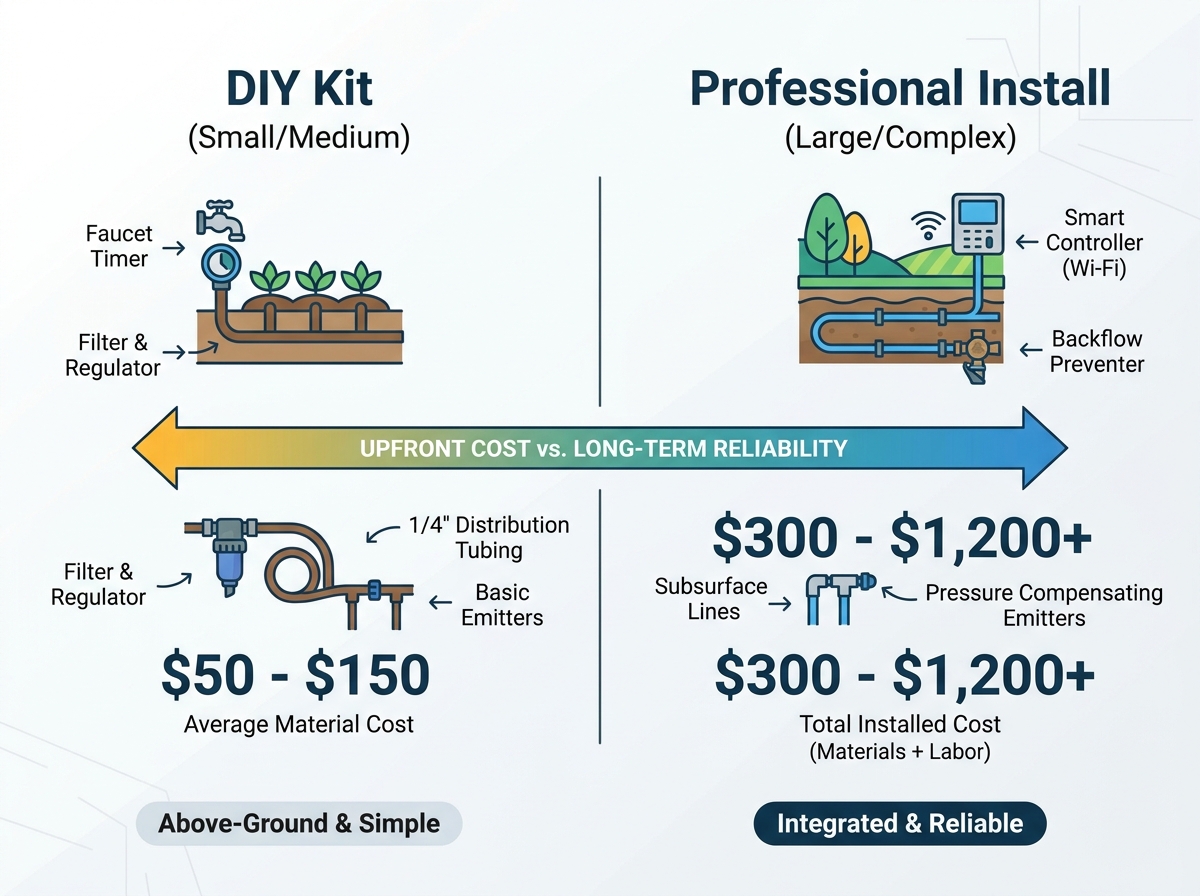
You must evaluate your mechanical skills before starting your project. Buying a pre-packaged bundle saves considerable money upfront. Hiring a professional guarantees superior reliability and municipal code compliance.
Starter bundles represent the lowest financial barrier available. They are incredibly ideal for above-ground applications. You can easily manage seasonal vegetable gardens yourself. Accessible outdoor faucets simplify the initial connection process. You simply screw the adapter onto the spigot.
However, the DIY route carries several hidden risks. Beginners frequently miscalculate household water pressure. They buy the wrong GPH (Gallons Per Hour) emitters. Furthermore, many people purchase proprietary kits lacking cross-brand compatibility. You might struggle to find replacement parts later. Your entire system could fail if the manufacturer discontinues those specific fittings.
Complex yards require expert planning and execution. Professionals excel at subsurface installations requiring deep trenching. They seamlessly integrate new micro-irrigation into existing sprinkler zones. They handle complex topography expertly. Steep slopes require specific pressure-compensating emitters to prevent pooling.
Labor generally accounts for 50% to 60% of a professional quote. You pay for their specialized knowledge and installation warranty. A customized drip line network ensures every plant receives precise hydration.
Evaluate local contractors carefully using these strict criteria:
Backflow Prevention: Ensure they include proper backflow devices for municipal compliance.
Zoning Logic: Ask how they separate thirsty plants from drought-tolerant species.
Warranty Coverage: Demand a written warranty covering both parts and labor.
Pressure Testing: Verify they test system pressure before burying the mainlines.
What exactly are you buying during a landscape upgrade? The raw plastic pipe costs very little. The functional accessories command much higher prices.
You have two main tubing options available. Blank tubing requires you to manually punch holes. Pre-punched emitter tubing contains factory-installed holes spaced evenly. You usually buy these materials in 100-foot rolls. Prices range from $15 to $40 per roll. If you need specific tubing recommendations, feel free to contact us for personalized advice.
Standard emitters cost mere pennies per unit. They work exceptionally well on perfectly flat ground. Pressure-compensating (PC) emitters cost slightly more. They deliver exact water volumes regardless of elevation changes. PC models prevent your lowest plants from drowning. They also stop your highest plants from starving.
These specialized components are crucial for long-term reliability. Do not skip them to save a few dollars.
Backflow Preventers: These devices stop contaminated yard water from entering your home supply. Local municipal codes often mandate their installation. Prices vary widely based on required compliance levels.
Pressure Regulators & Y-Filters: Standard home water pressure will instantly blow out micro-tubing. Regulators safely drop the pressure to 25 PSI. Y-Filters trap microscopic dirt. They are absolutely essential for preventing clogged emitters.
Timers/Controllers: Simple mechanical hose timers cost around $20. They require manual daily adjustments. Wi-Fi-enabled smart controllers cost between $100 and $250. They automatically adjust schedules based on local weather forecasts.
An irrigation project often encounters unforeseen physical hurdles. You must account for real-world environmental factors during planning.
Always check your local water authority rules. They might require formal permits for modifying irrigation mainlines. Ignoring local codes invites heavy fines. You might also have to hire a certified plumber for backflow testing.
Your existing soil heavily dictates your system design. Heavy clay soil absorbs water extremely slowly. You need closer emitter spacing here. You must use lower GPH emitters to prevent surface runoff. This requirement increases your total material volume. Conversely, sandy soil requires higher flow rates. Slopes dictate higher-end pressure regulation hardware to maintain even distribution.
System upkeep requires minor but consistent annual budgets. Consider these common expenses:
Annual winterization: Freezing climates demand system blowouts using air compressors. Expanding ice destroys plastic fittings quickly.
Pest damage: Rodents love chewing through exposed lines seeking fresh water. You will need replacement couplers frequently.
Hard water scaling: Mineral deposits eventually clog tiny emitter holes. You must replace filters or run chemical flushes annually.
Is this landscaping investment a smart financial decision? Let us examine the immediate environmental and financial benefits.
These localized systems deliver water directly to the plant root zone. They operate at 90% or higher efficiency levels. Traditional overhead sprays only achieve 50% to 70% efficiency. Wind blows standard spray mist away. The hot sun evaporates airborne droplets before they ever reach the dirt.
System Type | Average Efficiency | Evaporation Loss | Wind Drift Susceptibility |
|---|---|---|---|
Overhead Sprinklers | 50% - 70% | High | Severe |
Micro-Irrigation (Drip) | 90% - 95% | Extremely Low | None |
Calculate your potential monthly savings immediately. Check your local water rates. Reduced evaporation loss translates into significantly lower water usage. Your summer utility bills drop noticeably. These monthly savings accumulate rapidly over several watering seasons.
Many local water districts offer generous cash rebates. They literally pay homeowners to convert traditional turf spray zones. Switching to low-volume micro-irrigation offsets your initial installation costs. Some municipalities even provide free smart controllers. Check your local municipal website for specific application details.
Let us summarize the core decision framework. Small above-ground gardens need simple, cost-effective solutions. Buy a reputable DIY starter kit for those spaces. Complex property projects require dedicated professional help. If your project requires deep trenching, hire an expert. If you must tap into an existing irrigation manifold, seek professional help. Strict local water codes demand licensed landscapers. Always source at least three professional quotes before proceeding.
You should measure your exact square footage today. Test your outdoor spigot's water pressure using a simple gauge. Decide whether you want an automated or manual watering schedule. Gather all this crucial information before making any hardware purchases.
A: Soaker hoses have a significantly lower upfront cost. They are incredibly easy to snake through small gardens. However, they degrade rapidly under harsh sunlight. High-quality poly drip tubing costs more initially. Yet, it offers precise water control and lasts much longer. The poly tubing provides vastly superior value over time.
A: High-quality poly tubing realistically lasts 10 to 15 years. You must protect it from freezing temperatures and aggressive rodents. Cheap vinyl components degrade much faster. Sun exposure makes cheap plastic brittle. Burying the lines under protective mulch extends their lifespan significantly.
A: You should never connect raw tubing directly to a spigot. Standard household water pressure will blow the fittings apart. You must install a pressure regulator first. You also need a backflow preventer. This device stops contaminated soil water from siphoning into your drinking supply.
A: Water-wise landscaping definitely appeals to modern homebuyers. It demonstrates eco-friendly property management. However, it acts more as a curb-appeal maintainer than a direct value multiplier. Beautiful, thriving plants sell homes faster. The hidden irrigation network simply guarantees those plants survive hot summers effortlessly.


