
English


Views: 0 Author: Site Editor Publish Time: 2026-09-21 Origin: Site


Permanent crops require massive capital investment. Water delivery acts as the literal lifeblood of this investment. A poorly spec'd irrigation system heavily limits your yield control. For example, you lose the ability to manage deficit irrigation in viticulture. It also drives up long-term labor demands through constant repairs and maintenance.
You must shift your evaluation focus immediately. Do not look solely at upfront material prices. Instead, you need to prioritize 10-to-20-year system longevity, maintenance overhead, and precise volumetric control. Relying on seasonal equipment in a permanent field causes uneven crop growth. It also wastes thousands of gallons of water annually.
Technical and environmental variables strictly dictate your correct equipment selection. Wall thickness, emitter flow rates, and topography all play crucial roles. In this guide, we explore how to match these specifications to your specific agricultural environment. You will learn exactly how to build a resilient, high-performing irrigation infrastructure.
Crop-specific demands: Vineyards require precise water stress management (deficit irrigation), while orchards typically require broader root-zone coverage (often utilizing double drip lines).
Durability over initial cost: Heavy-wall drip line is standard for permanent crops; thin-wall drip tape is highly vulnerable to machinery and pest damage.
Topography dictates technology: Sloping terrain necessitates Pressure Compensating (PC) emitters to ensure uniform application.
Filtration is non-negotiable: Emitter flow rates must be paired with appropriate filtration systems to mitigate clogging risks.
Growers often confuse seasonal drip tape and heavy-wall tubing. The fundamental difference lies in wall thickness and manufacturing methods. Industry professionals measure wall thickness in "mils," where one mil equals one-thousandth of an inch. Seasonal drip tape typically ranges from 4 to 15 mil. Manufacturers design tape for single-season vegetable crops. Conversely, heavy-wall tubing ranges from 35 to 45 mil or more. Manufacturers extrude this tubing as a rigid, durable pipe.
Permanent crops demand infrastructure built for longevity. Orchards and vineyards require systems designed to last 10 to 20 years. Heavy-wall tubing requires a higher initial capital outlay. However, it amortizes beautifully over the lifespan of a permanent crop. You eliminate the labor costs associated with replacing damaged tape every single season. You also ensure continuous, uninterrupted water delivery during critical growth stages.
Thin-wall tape presents massive vulnerabilities in permanent agricultural settings. A 10-mil tape cannot withstand real-world orchard conditions. Coyotes and rodents easily bite through thin plastics seeking water during drought conditions. Ultraviolet (UV) radiation rapidly degrades thin materials over multiple seasons. Furthermore, thin tape rarely survives mechanical strikes. Tractors, mowers, and harvest machinery will easily tear through seasonal tape. You must select a heavy-wall drip line to survive these harsh daily environments.
Evaluating durability ensures consistent crop hydration. A broken line floods one area while starving another. This inconsistency ruins fruit quality. You avoid this entirely by investing in heavy-wall materials upfront. The structural integrity of thick-walled tubing provides peace of mind throughout the growing season.
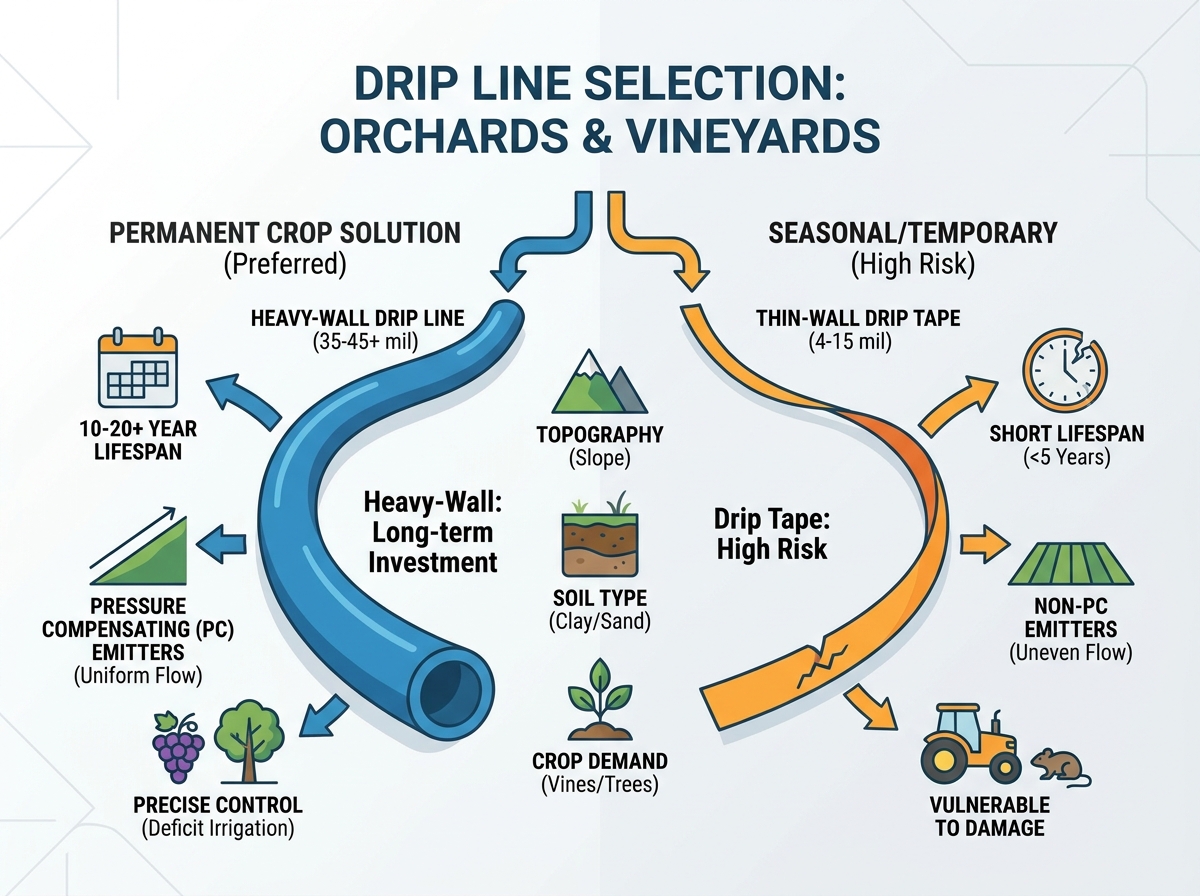
Selecting the right equipment requires matching technical specifications to your field conditions. Wall thickness dictates the physical lifespan of the tube. Industry standards dictate 40 to 45 mil for surface applications in permanent crops. If you plan a subsurface installation, you must use 50+ mil tubing. Subsurface lines face immense pressure from soil compaction and root movement. Thicker walls maintain their structural integrity underground.
Emitter flow rate directly determines your irrigation efficiency. You measure this in gallons per hour (GPH) or liters per hour (LPH). You must frame your flow rate selection around your specific soil infiltration rates. Heavy clay soils possess very low infiltration rates. They require low-flow emitters, typically between 0.26 and 0.4 GPH. Applying water faster causes surface runoff and pooling. Conversely, sandy soils possess high infiltration rates. Water travels straight down through sand very quickly. Sandy soils require higher flow emitters, typically 0.5 to 1.0 GPH. A higher flow rate pushes the water laterally before gravity pulls it below the active root zone.
Emitter spacing dictates the uniformity of your continuous wetted strip. The wetted strip is the continuous band of moisture beneath the tubing. Sandy soils require closer emitter spacing, roughly 18 to 24 inches. The water does not spread laterally, so you need more emission points. Heavy clay soils allow wider spacing, roughly 24 to 36 inches. Capillary action in clay pulls the moisture outward, bridging the gaps between emitters easily. Widely spaced orchard trees might also utilize wider spacing to concentrate water near the root balls.
You must also decide between Pressure Compensating (PC) and Non-PC emitters. PC emitters feature a flexible silicone diaphragm inside. This diaphragm regulates flow regardless of pressure fluctuations. PC emitters are absolutely essential for undulating terrain, sloped hillsides, and long lateral runs. They ensure the very first tree receives the exact same water volume as the last tree. Non-PC emitters simply output more water at higher pressures. You only use Non-PC emitters on perfectly flat terrain utilizing short run lengths.
Soil Type / Topography | Recommended Flow Rate | Recommended Spacing | Emitter Type |
|---|---|---|---|
Heavy Clay Soil | 0.26 - 0.4 GPH | 24 - 36+ inches | Matches Topography |
Sandy Soil | 0.5 - 1.0 GPH | 18 - 24 inches | Matches Topography |
Sloped / Undulating Terrain | Depends on Soil | Depends on Soil | Pressure Compensating (PC) |
Perfectly Flat Terrain | Depends on Soil | Depends on Soil | Non-PC (or PC) |
Different permanent crops feature wildly different agronomic needs. Viticulture requires extreme precision regarding water application. Grape growers actively manage vegetative vigor to optimize fruit quality. They achieve this through regulated deficit irrigation (RDI). RDI involves intentionally stressing the vines at specific phenological stages. This stress forces the vine to concentrate sugars and phenolic compounds into the grapes. You cannot execute RDI without precise volumetric control. If your emitters flow unevenly, some vines grow excess canopy while others collapse from severe dehydration.
Vineyard setups typically utilize a single tube. Growers commonly suspend this tube on a lower fruiting wire. Suspending the equipment keeps it off the ground. This physical elevation facilitates mechanical weed control under the vines. It also severely reduces rodent damage. Mice and voles rarely climb wires simply to chew on plastic.
Orchards require an entirely different configuration strategy. Nut and fruit trees grow massive structural root systems. A single tube cannot provide adequate mature root-zone coverage. Orchard configurations commonly utilize double lines. You place one tube on each side of the tree trunk.
Watering both sides of the tree encourages balanced, symmetrical root development. If you only water one side, the roots exclusively grow toward the moisture. Asymmetrical root systems create severe structural weaknesses. High winds easily topple mature trees lacking balanced root anchorage. This "wind-throw" effect destroys decades of growth in minutes. Two tubes also deliver higher total volumes of water during peak summer evapotranspiration periods.
Long-term system survival depends entirely on proactive threat mitigation. Clogging represents the single largest threat to micro-irrigation. You must defend against both physical and biological blockages. Modern emitters utilize a "tortuous path" internal design. This labyrinth-like channel creates aggressive water turbulence. The turbulence continuously flushes small particulates out of the orifice.
Your water source quality dictates your exact clogging defense. Well water often contains heavy sand or dissolved minerals like iron and calcium. Surface water from canals contains algae, bacteria, and organic silt. You must pair your emitters with appropriate sand media or disc filters based on this source data.
Subsurface Drip Irrigation (SDI) introduces unique maintenance challenges. Burying the equipment eliminates evaporation and mechanical damage. However, it invites aggressive root intrusion. Thirsty roots actively seek out the emission orifices and grow inside them.
You can counter SDI risks using these proven strategies:
Chemical Treatments: Inject periodic chemical barriers (like Trifluralin) to stunt root tip growth near the orifice.
Copper-Impregnated Emitters: Utilize specialized emitters featuring copper oxide shields. Copper naturally repels root intrusion without harming the plant.
Vacuum Relief Valves: Install air vents at the highest points of the field. When the water shuts off, draining lines create a vacuum. Without valves, this vacuum sucks mud and debris directly into the emitters.
Above-ground pest management also demands serious attention. Real-world challenges often involve wildlife seeking hydration.
Implement these strategies to mitigate surface damage:
Suspension: Hang tubing on catch-wires above the soil line away from small ground rodents.
Coloration: Some manufacturers offer specific tube colorations or striped patterns designed to blend in or deter bird pecking.
Wall Thickness: Always default to heavier walls (45+ mil) in areas experiencing heavy coyote or jackrabbit populations.
You must gather comprehensive field data before contacting suppliers. Guessing your specifications guarantees poor performance. Start by physically testing your soil composition across different field blocks. Map your topographic elevation changes accurately. Even a three percent grade impacts hydraulics over a long run. Finally, measure your exact water source capacity. You need to know your well's flow rate (GPM) and dynamic operating pressure.
Once you gather this data, begin your vendor evaluation. Do not choose a manufacturer based solely on the lowest quote. Evaluate them based on their warranty terms. A strong warranty indicates manufacturing confidence. Investigate local dealer support. You will inevitably need replacement parts on short notice during peak summer heat. Ensure your local distributor stocks the exact fittings and valves your system utilizes.
Always consider pilot testing before a farm-wide deployment. Purchase a small roll of your chosen tubing. Test a specific emitter flow rate and spacing on a single crop block. Monitor the wetted pattern beneath the soil surface. Check for runoff or deep percolation. Adjust your specifications based on this real-world pilot test before ordering thousands of feet of material.
Choosing irrigation equipment represents a permanent infrastructure decision. It is never a simple seasonal supply purchase. The components you select today dictate your operational efficiency for the next two decades. Taking shortcuts on wall thickness or filtration will cost you exponentially more in labor and crop loss later.
Matching emitter specifications to your soil type and topography remains the most critical step. PC emitters handle the slopes, while exact flow rates handle the soil infiltration. Respecting these agronomic realities ensures uniform crop quality across your entire acreage. Do not leave your multi-million dollar investment to chance.
We strongly recommend taking your gathered field data to a professional. Consult with an irrigation specialist or an agronomist to finalize your system hydraulics. They will calculate friction loss, pump sizing, and optimal zone layouts. Please feel free to contact us to request a tailored quote and review your field's specific requirements.
A: A heavy-wall tube typically lasts 10 to 20 years in a permanent orchard. Longevity depends heavily on proactive maintenance, regular flushing, and strict water quality management. Protecting the tubing from direct mechanical strikes and flushing chemicals to clear mineral buildup ensures it reaches its maximum lifespan.
A: Yes, you often still need PC emitters. Even land appearing visually flat contains minor elevation changes. Furthermore, friction inside the pipe causes pressure drops over long lateral runs. PC emitters overcome this friction loss, guaranteeing the last tree gets identical water volumes as the first.
A: Yes, fertigation is highly effective and widely practiced. However, you must ensure your fertilizers are completely water-soluble. You must also implement strict post-application flushing. Running clear water through the lines after fertilizing prevents chemical residues from crusting and clogging the emitter pathways.
A: Surface lines allow for easy visual inspection, fast repairs, and lower installation costs. Subsurface systems significantly reduce evaporation loss, eliminate surface rodent damage, and protect lines from tractor strikes. Choose subsurface if water conservation is paramount, but prepare for more complex root-intrusion maintenance.


