
English


Views: 0 Author: Site Editor Publish Time: 2026-06-12 Origin: Site


Every grower faces a critical decision when designing an agricultural or landscape irrigation system. You must balance immediate budget limits against the need for durable, reliable infrastructure. Choosing between lower upfront costs and long-term durability is the core dilemma for growers and landscapers alike. This decision is not about finding a universal "best" product. Instead, it requires a precise alignment between your crop lifecycle, operating budget, and field terrain.
Selecting the wrong material inevitably leads to wasted capital on temporary crops. Conversely, you might face frustrating, chronic maintenance on permanent installations. In this guide, we explore the structural and functional differences between these popular irrigation methods. You will learn how the specific application ultimately dictates the material choice. We will also help you navigate crucial pressure requirements, filtration dependence, and long-term deployment strategies.
Application dictates material: Drip tape is engineered for seasonal, straight-row crops; drip line is built for permanent landscapes, orchards, and multi-year garden beds.
Lifespan vs. Cost: Drip tape offers low initial cost but requires replacement every 1–3 years. Drip line requires higher upfront investment but lasts 7–10+ years.
Pressure requirements: Drip tape operates at strict, low-pressure thresholds (typically 8–15 PSI) and requires precise pressure regulation to prevent blowouts.
Filtration dependence: Both systems require filtration, but the micro-emitters in drip tape are highly susceptible to clogging without minimum 150-mesh filters.
Understanding the physical construction of your irrigation tubing prevents catastrophic field failures. Manufacturers build these two products for entirely different mechanical tolerances.
A standard drip tape specification ranges from 5 to 15 mil in thickness. It naturally collapses flat when unpressurized. This thin-wall design reduces manufacturing and shipping costs significantly. However, it sacrifices structural rigidity. We contrast this against heavy-duty polyethylene tubing. A standard drip line typically features a 45+ mil thickness. It retains a rigid, cylindrical shape regardless of internal water pressure. This robust exterior protects the system against severe environmental stressors.
Emitter integration varies significantly between the two materials. Manufacturers engineer thin-wall tubing using continuous, laser-slit, or molded labyrinth emitters. These slit outlets open under pressure and snap closed when water stops. This mechanical action prevents root intrusion in subsurface applications. In contrast, rigid lines feature factory-installed internal cylindrical emitters. Alternatively, they support external punch-in emitters. You can customize emitter spacing on rigid tubing to match highly specific plant placements.
Flow rates and maximum run lengths depend on tube diameter. They also rely heavily on friction loss principles. We observe distinct operational differences in the field.
Standard Flow Rates: Thin-wall materials typically deliver 0.2 to 1.0 gallons per minute per 100 feet. Rigid tubing often measures output in precise gallons per hour (GPH) per emitter.
Friction Loss Dynamics: Thin-wall materials experience higher friction loss over long distances. This physical limitation restricts maximum run lengths.
Run Length Maximums: A standard 5/8-inch thin-wall tube might maximize its run around 300 to 600 feet. A 1/2-inch rigid tubing can push water significantly farther. You can extend this even more using pressure-compensating emitters.
Deploying thin-wall tubing makes exceptional sense in specific agricultural contexts. It excels when rapid deployment and low initial costs take priority.
Primary success scenarios involve high-density agriculture. We frequently see market gardens and large-scale row crops utilize this material. Corn, tomatoes, hemp, and temporary seasonal plantings thrive under this irrigation method. The thin-wall material aligns perfectly with the short-term lifecycle of these fast-growing crops.
The return on investment advantages make this material highly attractive for massive acreage. It costs mere fractions of a cent per foot. You can achieve economical scaling over hundreds of acres of straight, flat rows. The initial capital outlay remains incredibly low. This allows commercial growers to allocate precious budgets toward high-quality seeds, fertilizers, and seasonal labor.
Implementation realities demand careful handling and strict field management. At the end of the harvest season, farm workers easily roll it up. They either discard or recycle the plastic material. However, it remains highly vulnerable during active growth stages.
Rodents and insects easily chew through the thin plastic searching for water.
Accidental punctures from hoes and garden tools happen frequently.
UV degradation breaks down the plastic rapidly unless you bury or mulch the lines.
Technical constraints dictate strict field requirements. You absolutely need flat terrain for optimal performance. Standard non-compensating emitters lose uniformity on slopes. You could use pressure-compensating thin-wall tubing. However, this upgrade increases the cost significantly, defeating the primary budget advantage. Furthermore, the system demands strict low-pressure regulators. Pushing standard municipal pressure through these lines will instantly rupture the seams.
Heavy-duty rigid tubing shines in completely different environments. It provides steadfast reliability for long-term landscaping and perennial agriculture.
Primary success scenarios focus strictly on long-term infrastructure. Orchards, vineyards, foundation plantings, and raised beds benefit immensely from this choice. Perennial landscaping requires a durable watering solution. These applications demand a resilient system capable of enduring harsh weather for a decade or more.
The return on investment advantages center almost entirely on one-time installation labor. You design, install, and bury the system just once. It easily survives severe winter freezes, provided you drain it properly in autumn. Heavy foot traffic and occasional machinery passes will not crush the 45+ mil tubing. This impressive durability eliminates the frustrating annual labor of pulling and replacing lines.
Implementation realities highlight extreme flexibility in challenging, permanent environments. You can snake the tubing around established obstacles seamlessly.
Curved Layouts: The rigid yet pliable tubing navigates curved flower beds and highly uneven terrain without kinking.
Slope Management: Pressure-compensating (PC) emitters maintain uniform flow. You achieve equal watering rates at the top and bottom of steep hills.
Targeted Delivery: External punch-in emitters let you direct water precisely to the root zones of scattered, mature trees.
Technical constraints primarily involve upfront logistics and commitment. High initial material and shipping costs often deter budget-conscious buyers. The rigid rolls require substantial barn or garage storage space. They feel bulky and heavy to move across large fields. Once staked into established root zones, modifying the layout proves quite difficult. You must confidently commit to your garden design before planting.
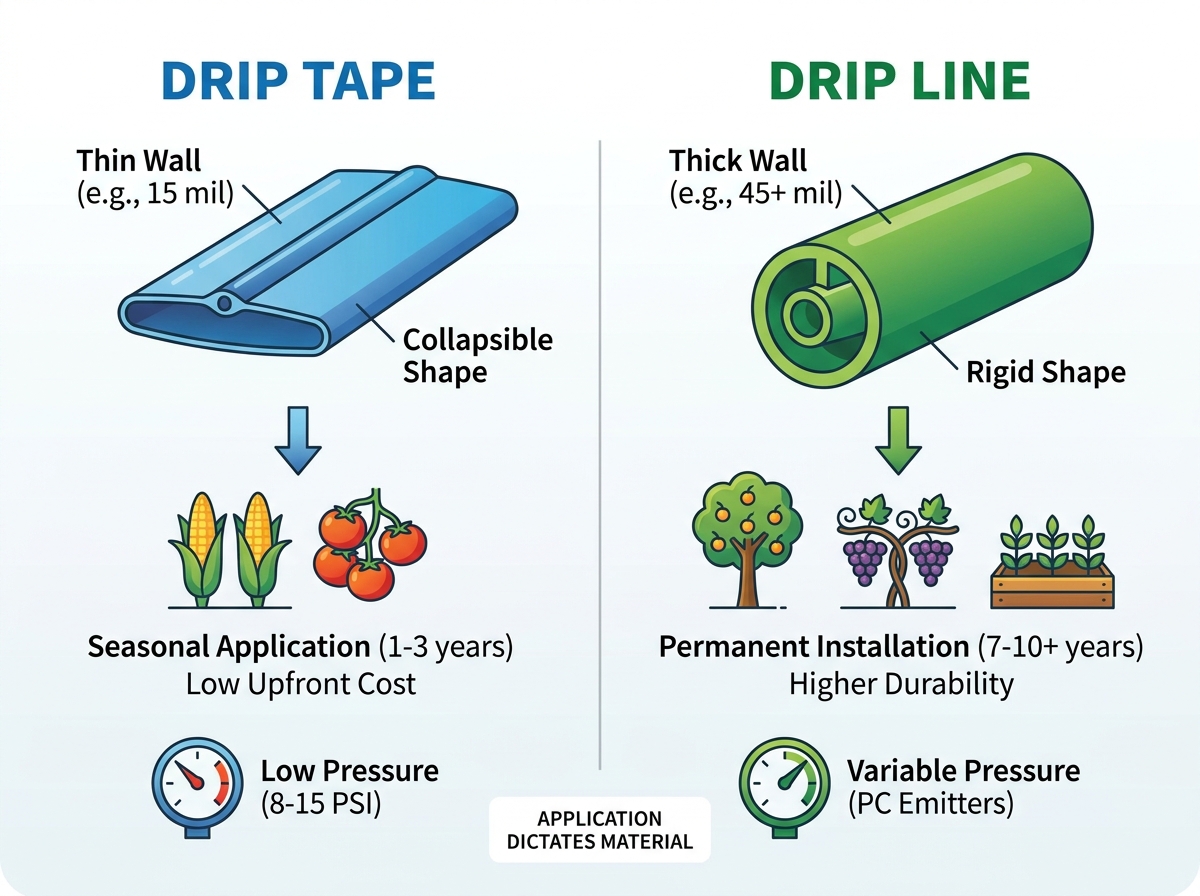
Comparing these two systems requires evaluating both immediate costs and physical landscape constraints. Review the evaluation matrix below before finalizing your irrigation blueprint.
System Design Evaluation Matrix
Feature | Thin-Wall Tubing | Heavy-Duty Rigid Tubing |
|---|---|---|
Wall Thickness | 5 to 15 mil | 45+ mil |
Lifespan | 1 to 3 seasons | 7 to 10+ years |
Ideal Terrain | Flat, straight rows | Slopes, curved beds, uneven ground |
Initial Material Cost | Very low | High |
Installation Labor | Repeated annually | One-time intensive setup |
We must compare upfront roll costs realistically. Purchasing 1,000 feet of thin-wall tape requires a tiny fraction of the budget needed for 1,000 feet of heavy-duty line. However, focusing solely on the initial purchase price hides the true labor burden. You must factor in annual replacement labor. The hidden cost of pulling, disposing, and reinstalling thin-wall tubing every spring adds up quickly. A 10-year rigid tubing deployment requires a higher initial check. Yet, it practically eliminates your annual reinstallation labor.
Assess your water quality constraints before purchasing any tubing. Well or pond water heavily impacts thin-wall materials. High silt and algae concentrations overwhelm the tiny micro-emitters. This demands heavier filtration investments to prevent catastrophic clogging. Rigid tubing handles minor particulate matter slightly better due to larger emitter pathways. However, both systems require diligent filtration. We strongly recommend utilizing a minimum 150-mesh filter. Without it, you risk plugging the entire zone permanently.
Evaluate elevation changes across your property carefully. Standard thin-wall materials lose uniformity on hills. Water rushes to the lowest point, drowning bottom crops while starving top rows. You cannot ignore gravity. Conversely, PC rigid tubing guarantees precise delivery everywhere. The internal diaphragm regulates output perfectly regardless of elevation dips. This guarantees a balanced moisture profile across complex topography.
Designing a reliable irrigation network requires strict adherence to fluid dynamics. Mixing materials or ignoring pressure limits will destroy your setup.
The mixing fallacy traps many novice growers. Running both materials on the exact same irrigation zone always fails. They possess completely differing PSI requirements and wildly different precipitation rates. Heavy-duty tubing typically needs 20 to 40 PSI to activate PC emitters. Thin-wall materials will explode at this pressure. Furthermore, the application rates never match. You will inevitably overwater one section while severely underwatering another.
Pressure blowouts present a constant, real-world danger. Novices frequently connect thin-wall tubing directly to municipal water supplies. City water usually runs between 40 and 70 PSI. Connecting without a dedicated 10-15 PSI pressure reducer causes immediate blowouts. The seams split rapidly, flooding your field and destroying the equipment. Always install a high-quality pressure regulator immediately after your filter.
Winterization highlights strict end-of-season realities. Rigid heavy-duty tubing must be flushed thoroughly. In freezing climates, you must blow out the lines using compressed air. Any residual water will freeze, expand, and crack the thick plastic. Conversely, thin-wall materials are typically rolled up or abandoned. If you intend to reuse thicker 15-mil tape, you must drain it carefully. Store it in a rodent-free environment away from freezing temperatures. Here, understanding your drip tape winterization steps saves thousands of dollars in spring repairs.
Choosing the correct irrigation material ensures healthy crops and preserves your sanity. We summarize the shortlisting logic simply. Buy thin-wall tubing for seasonal cash crops planted in long, straight rows. Invest in heavy-duty rigid tubing for permanent infrastructure, uneven terrain, and perennial root zones.
Match the material lifespan directly to your crop lifecycle.
Never mix both materials on a single irrigation valve.
Always prioritize heavy filtration, regardless of your final tubing choice.
Take action today by auditing your current water pressure. Calculate your total row footage accurately. Finally, select the appropriate pressure regulator and filter for your chosen tubing to guarantee long-term operational success.
A: Yes, depending on the mil thickness. A heavier 15-mil product can last two to three years if you handle it carefully. You must flush it, roll it gently, and store it in a rodent-proof, climate-controlled space over winter. However, standard 8-mil products are typically designed for single-use applications. Pulling them up almost always causes stretching and micro-tears, rendering them useless for a second season.
A: Yes, but you cannot glue or clamp it directly. You must use specific barbed tape loc fittings designed exclusively for thin-wall materials. Additionally, because standard PVC or poly systems operate at higher pressures, you must install a pressure reducer. Dropping the pressure to 10-15 PSI prevents the thin-wall seams from rupturing upon startup.
A: Burying is not strictly required, but we highly recommend it. Burying or heavily mulching protects thin-wall materials from severe UV degradation. It also prevents accidental punctures from garden tools. Furthermore, hiding the tubing reduces rodent and bird damage. Rigid heavy-duty tubing resists UV rays better, but burying it keeps the landscape tidy and protects it from lawnmower strikes.
A: Both systems deliver exceptional water efficiency compared to overhead sprinklers. The actual water volume used depends entirely on the emitter flow rate (measured in gallons per hour) and the spacing between emitters. The tubing type itself does not dictate water consumption. Proper scheduling, precise pressure regulation, and routine maintenance determine your overall conservation success.


