English


Views: 0 Author: Site Editor Publish Time: 2026-08-03 Origin: Site


Choosing the wrong irrigation emitter architecture leads to misaligned watering zones. It frequently escalates daily maintenance costs and wastes expensive installation labor. Growers often face severe operational setbacks when maturing crops outgrow their initial water distribution layout. You need reliable irrigation systems to prevent dry spots and crop stress. While both main emitter systems deliver targeted water directly to the active root zone, they differ fundamentally in design. The core difference lies strictly in where and how you position the emitter relative to the tubing. This guide breaks down the operational differences, material implications, and deployment realities of inline versus online setups. We will help you match the right architecture to your specific crop layout and field conditions. You will also learn how to plan for future agricultural scalability without overspending on redundant materials.
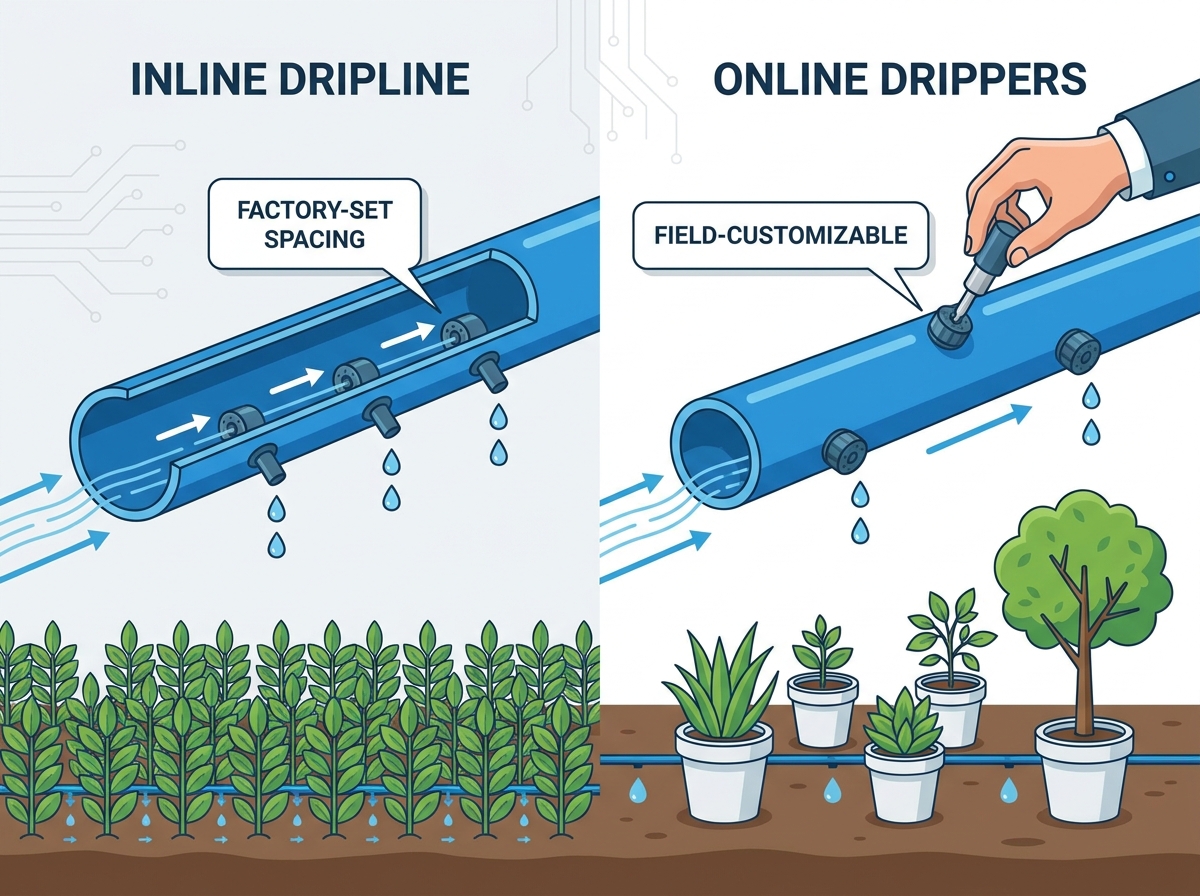
Inline drip lines feature pre-installed internal emitters spaced at precise, factory-set intervals, making them the standard for high-density, uniformly spaced row crops.
Online drippers (punch-in emitters) are manually installed on the outside of blank tubing, offering maximum flexibility for irregularly spaced plants, orchards, or container nurseries.
Labor vs. Material Trade-off: Inline systems minimize field installation time, while online systems require higher initial installation labor but offer cheaper, localized emitter replacements.
System Scalability: Online systems allow growers to add or move emitters as crop needs change or plants mature, a flexibility inline systems lack.
Manufacturers produce inline tubing with emitters permanently welded inside the inner pipe wall. These emitters sit at strict, factory-set intervals. Common agricultural spacing options include 12, 18, and 24 inches. The internal emitters feature complex labyrinth flow paths. These paths create turbulent water movement to prevent sediment buildup.
In terms of implementation reality, this tubing arrives completely field-ready. Installers simply roll out the tubing along the crop rows. They do not need to manually punch holes. They skip the tedious process of inserting individual emitters. This pre-assembled nature allows tractors to lay miles of tubing rapidly. Large commercial farms rely heavily on this mechanized deployment.
However, this factory integration introduces specific limitations. The emitter spacing remains entirely fixed. You cannot move an internal emitter if a plant grows off-center. If a specific plant dies, the system continues watering empty soil. Growers must accept this rigid structural reality. You trade spatial flexibility for massive installation speed.
Best Practice: Always install air relief valves at the highest points of your inline system. This prevents a vacuum effect from sucking dirt into the internal emitters when the system shuts off.
Online systems rely on blank polyethylene distribution tubing. Installers manually punch discrete, external emitters into the pipe wall. You place these emitters exactly where the plant needs water. You start with a blank drip line and build a highly customized watering network.
This implementation reality requires specialized hole punches. Workers perform manual insertion for every single watering point. The emitters sit visibly on the outside of the tube. This external placement defines the entire operational strategy. It requires intensive initial manual labor but grants ultimate control.
The advantages of this approach center on complete spatial control. You dictate exact emitter placement. You can mix different output flow rates on the same line. For example, a large tree might receive a 2.0 gallon-per-hour (GPH) emitter, while a smaller shrub gets a 0.5 GPH emitter. Furthermore, you can attach micro-tubing to these external emitters. This allows you to route water directly into remote landscape pots or hanging baskets.
Common Mistake: Never use a standard drill or a generic nail to puncture the blank tubing. Always use the manufacturer-approved punch tool. Improper holes lead to immediate leaks around the emitter barb.
Inline architectures perform optimally for dense, continuous root zones. You will typically see them in hedges, vineyards, and vegetable row crops. Commercial agriculture relies on them because tight plant spacing creates a uniform root trench. The continuous wetting pattern overlaps perfectly beneath the soil surface.
Online architectures thrive in scattered plantings. They adapt beautifully to changing layouts and expanding root zones. Mature tree orchards, landscape containers, and complex greenhouses utilize them extensively. If you grow crops in pots, online systems allow you to direct water precisely into each container. You avoid wasting water on the barren ground between pots.
Inline setups offer highly scalable deployment. Trenching or surface laying happens rapidly. This speed reduces upfront labor overhead significantly. Mechanized spools can deploy multiple lines simultaneously behind a tractor.
Online setups demand a labor-intensive setup. Every single emitter requires physical alignment, punching, and insertion.
Workers must lay out the blank tubing across the designated zone.
Installers must identify the precise location of every target plant.
Operators use a specialized tool to punch the hole.
Workers manually press the barbed emitter into the hole until it snaps into place.
This process increases the risk of human error. It also introduces repetitive strain issues for workers during massive rollouts.
Inline emitters remain highly protected from physical external damage. Machinery, field workers, and animals rarely dislodge them because they sit safely inside the tube wall. However, maintenance becomes complex when clogging occurs. If an internal emitter permanently clogs from mineral scaling, you face a tough repair. You must cut out the affected tubing section entirely. You then splice in a new segment using barbed couplings.
Online external emitters remain completely exposed. They are prone to accidental dislodging by boots, rakes, or foraging animals. Conversely, maintenance is incredibly straightforward. If a single online emitter clogs, you pull it out. You simply push a new emitter into the existing hole. You do not need to cut the main pipe.
Feature | Inline Systems | Online Systems |
|---|---|---|
Emitter Location | Inside the tubing | Outside the tubing |
Spacing Flexibility | Fixed (Factory-set) | Variable (Manual placement) |
Installation Speed | Fast (Mechanized) | Slow (Manual insertion) |
Clog Repair | Cut and splice tubing | Replace individual emitter |
Best Application | Row crops, vineyards | Orchards, potted plants |
Inline tubing generally presents a higher material cost per foot compared to blank tubing. This price difference exists because the product bundles the cost of the internal emitters directly into the pipe. The complex manufacturing process extrudes the plastic around the emitters. This sophisticated production commands a premium price at the supply store.
Blank polyethylene tubing remains extremely cheap to manufacture and purchase. However, you must buy the external online emitters separately. For high-density plantings, buying thousands of individual online emitters quickly exceeds the bundled cost of factory-made tubing. You must calculate your specific plant density to determine true material budgets.
While blank tubing costs less initially, online systems demand substantially higher labor budgets. Paying a crew to manually punch thousands of holes dramatically increases your setup expenses. Commercial operators must weigh this manual labor heavily against initial material savings. An inline system saves countless labor hours, often offsetting its higher initial purchase price within the first planting season.
Scalability defines the true long-term value of your chosen architecture. Online systems allow growers unparalleled post-installation adjustments. As a newly planted tree grows, its water demand increases. Its root zone expands outward. With an online system, you simply punch a second or third emitter into the blank line near the drip canopy. You scale water delivery dynamically.
Inline systems completely lack this localized scalability. If a mature crop block requires more water, you cannot simply add internal emitters. You must increase the runtime for the entire zone, which might overwater adjacent younger plants. Alternatively, you must lay a parallel secondary line to increase water volume across that specific bed. This requires purchasing entirely new rolls of tubing.
Both online and inline systems require stable water pressure to function correctly. Without regulation, emitters close to the water source discharge aggressively. Emitters at the far end of the run barely drip. Elevation changes severely compound this problem. Sloping terrain alters internal line pressure dramatically, demanding specific emitter technologies to maintain crop uniformity.
Industry standards provide Pressure Compensating (PC) variants for both architectures.
PC Inline Tubing: The internal welded emitters contain a flexible silicone diaphragm. This diaphragm expands and contracts based on internal water pressure, ensuring a steady flow rate.
PC Online Emitters: The external punch-in modules house a similar regulating membrane inside their small plastic casings.
Non-PC Alternatives: Standard turbulent-flow emitters cost less but fluctuate wildly depending on incoming pressure and topography.
Regardless of choosing inline or online, PC technology remains strictly necessary for sloped terrain. You also need it for excessively long lateral runs. PC ensures the first plant and the last plant receive identical water volumes. If your field features rolling hills, non-PC emitters will flood the valleys and starve the hilltops. Always specify PC technology when structural elevation variances exist. This uniform delivery guarantees consistent crop yields across uneven acreage.
Selecting the ideal architecture requires analyzing your physical layout and labor resources. Review the following criteria to make a confident engineering choice.
Choose Inline Drip Lines if:
You are planting tight row crops like strawberries, lettuce, or corn.
Your field features highly uniform spacing between every plant.
You need subsurface deployment (SDI) to protect lines from tractors.
You require rapid, mechanized installation across dozens of acres.
You want to eliminate the repetitive labor of punching holes.
Choose Online Emitters if:
You are managing potted plants or nursery containers.
You operate orchards with varying tree maturity and different water needs.
You maintain complex residential or commercial landscapes.
You need varying flow rates on a single distribution line.
You plan to expand the root zone watering area manually over several years.
Many advanced operators avoid choosing just one system. They utilize hybrid approaches to maximize efficiency. A common strategy involves using blank distribution tubing as a primary sub-main line. Growers then branch off from this sub-main using short segments of inline tubing for specific planting beds.
This allows you to punch online connectors into the main line wherever a bed begins. You then rely on the inline segments to rapidly water the dense rows. This strategy perfectly balances custom routing with rapid row deployment. If you need help calculating flow rates or configuring a hybrid layout, you can always contact us for professional guidance.
The choice between inline and online systems is rarely about identifying a superior technology. Instead, it is about matching the engineering to the spatial reality of your planting environment and labor availability. Inline systems dominate high-density, uniform agriculture through rapid deployment and factory precision. Online systems dominate custom landscapes, orchards, and nurseries by providing ultimate spatial flexibility and localized scalability.
Map out your field uniformity thoroughly before purchasing materials. Calculate your available installation labor hours to avoid surprise setup costs. Finally, consult with an irrigation specialist to spec the correct flow rates, pressure compensation needs, and filtration requirements for your shortlisted system.
A: Yes, but it is generally redundant and alters the engineered flow rate of the zone. It is typically only done as a temporary patch for a dead internal emitter. Mixing them makes calculating total zone water usage very difficult.
A: Inline tubing is far superior for SDI. Online external emitters are easily snapped off during trench burial or subsequent soil settling. Internal factory-welded emitters remain protected inside the pipe wall beneath the soil.
A: Not if installed correctly. Blank tubing is designed to shrink-seal around the barbed end of a properly punched emitter. Leaks only occur if the hole is punched too large, at a severe angle, or if the tubing is old and degraded.