
English


Views: 0 Author: Site Editor Publish Time: 2026-06-26 Origin: Site


Selecting the right irrigation hardware is only half the battle for successful crop yields. Incorrect placement often leads to uneven wetting patterns, root disease, or complete system failure. Many growers invest heavily in infrastructure but miss the mark on field layout. Proper placement maximizes water efficiency. It reduces weed pressure significantly across the field. Furthermore, it directly impacts crop uniformity and overall return on investment. Growers face tight margins today. Optimizing your water delivery guarantees better resource management and healthier plants. You need a reliable strategy tailored to your exact environmental conditions. This guide breaks down exact placement parameters based on soil type. We also explore crop layout configurations and specific hardware specifications. By the end, you will know how to finalize your installation strategy perfectly.
Orientation is non-negotiable: Emitters must always face upward to prevent soil and sediment ingestion.
Soil dictates distance: Sandy soils require tighter placement to the root zone, while clay and loam allow for wider spacing due to lateral capillary action.
Placement dictates product: Surface installations can utilize thin wall drip tape, while subsurface installations require heavier mil specifications to withstand soil weight and pest pressure.
Run lengths matter: Tape placement must adhere to maximum run-length constraints to maintain uniform pressure from the header to the flush valve.
You have two primary approaches for field installation. You must compare these options carefully before buying equipment. Each approach establishes different criteria for agricultural success. We evaluate them based on field longevity and maintenance needs.
Surface installation keeps your irrigation system visible at all times. It works best for seasonal crops. Frequently tilled fields benefit greatly from this adaptable approach. Growers needing easy visual inspection prefer it. You can spot leaks or clogs instantly by walking the rows. Field hands can repair damaged sections in minutes. However, you must consider certain physical vulnerabilities. The lines face higher UV degradation from direct sunlight. Plastic breakdown occurs faster above ground. Rodent damage becomes a daily threat. Mechanical interference from tractors or field workers happens often. Wind can also shift empty lines away from the root zone before pressurization.
Subsurface drip irrigation buries the hardware completely. It suits multi-season use perfectly. High-traffic commercial agriculture relies heavily on SDI. Burying lines minimizes surface evaporation entirely. This keeps the soil surface dry. A dry surface prevents weed seeds from germinating. You must use specialized agricultural drip tape for this method. These applications typically demand 15-mil thickness or higher to survive soil weight. Finding emitter clogs becomes much harder underground. Therefore, you need rigorous filtration systems at the pump station. Air and vacuum relief valves are absolute necessities. They prevent the system from sucking mud into the emitters when you shut the water off.
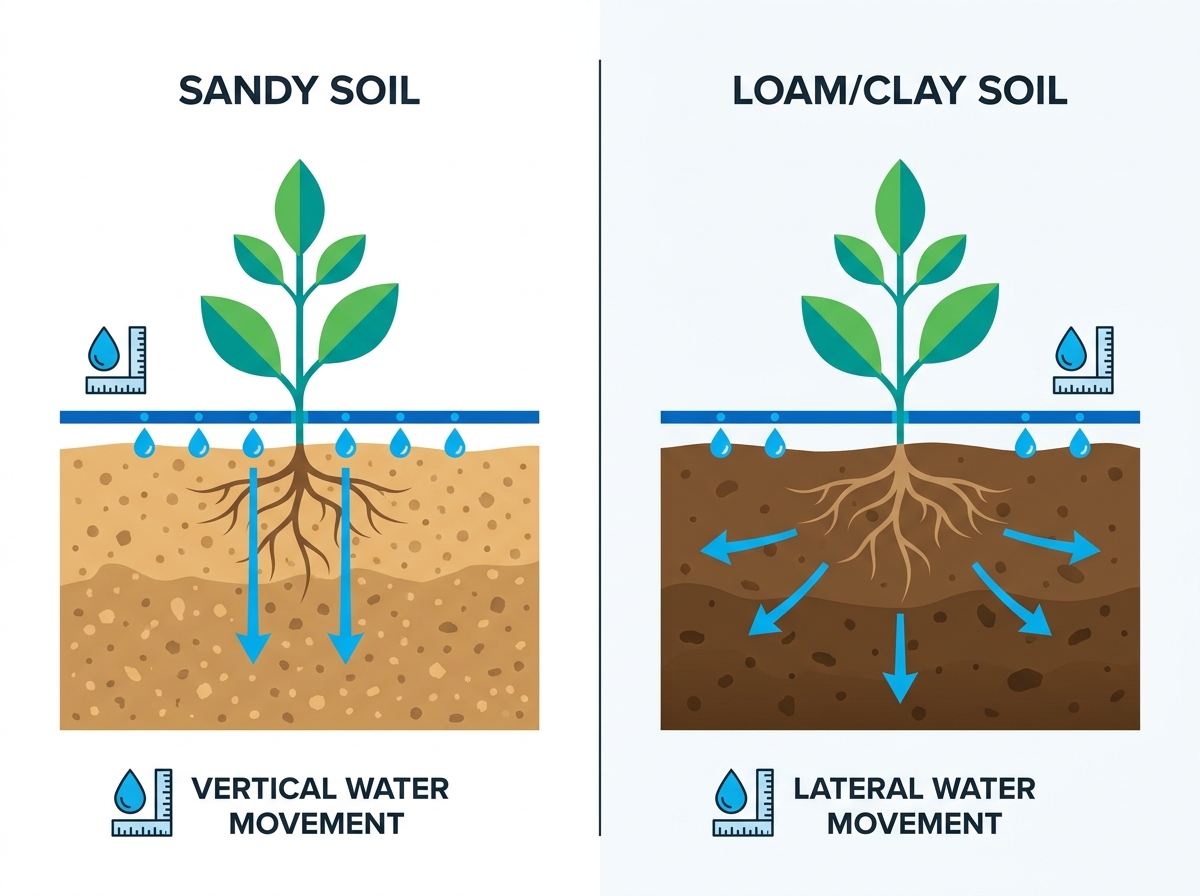
Evaluating soil hydrology ensures accurate root zone targeting. You cannot guess this distance based on visual preference alone. The specific texture of your dirt dictates how water travels underground.
Water moves differently depending on soil texture. Your ultimate goal involves creating overlapping wetting patterns. These moisture zones must occur within the active root zone. Capillary action dictates lateral water movement. Cohesion and adhesion forces pull water outward. If these forces are weak, water simply drops downward due to gravity.
Sandy soils drain very quickly. The large particles create massive air gaps. Water moves straight down through the profile. It rarely travels outward. You must place lines as close to the plant base as possible. We typically recommend placing them within 2 to 4 inches of the main stem. Wider spacing leaves roots completely dry. You will see a narrow wet spot on the surface. The moisture does not spread horizontally enough to support plants further away.
Loam and clay soils hold moisture exceptionally well. They consist of microscopic particles tightly packed together. Water moves laterally through these dense textures very efficiently. You can place lines 6 to 12 inches from the plant stem safely. This wider spacing provides a massive benefit. It reduces the risk of crown rot significantly. Fungal diseases struggle to develop when the main stem stays dry. The water still effectively feeds the expansive root system underground.
Plant stage heavily dictates placement distance. Direct seeding requires constant moisture at the topsoil layer. Lines must sit close enough to wet the surface soil thoroughly. Seeds cannot sprout in dry dirt. Transplants require a different approach. You should place lines slightly further away from young plugs. This encourages outward root expansion over time. Roots naturally chase water. Forcing them to reach outward builds a sturdier, more resilient plant structure.
Soil Hydrology and Placement Chart
Soil Type | Water Movement Pattern | Recommended Distance from Stem | Capillary Action Strength |
|---|---|---|---|
Sand | Vertical / Downward | 2 to 4 inches | Very Low |
Loam | Evenly Radial | 4 to 8 inches | Moderate |
Clay | Lateral / Horizontal | 6 to 12 inches | High |
Your farm setup dictates specific layout models. You must scale these configurations properly. Different plants demand different moisture volumes and root space.
This layout serves densely planted row crops well. Lettuce, onions, and carrots thrive on single lines. You simply run a single line of flat drip tape directly down the center of the bed. It provides uniform moisture for narrow planting zones. Installation happens quickly. Material costs stay extremely low. Single lines perform best on beds under 24 inches wide. Anything wider might leave the outer edges too dry.
Wide beds require double-line configurations. Heavy-feeding crops demand extra water volume to produce fruit. Tomatoes, pumpkins, and melons grow better under this layout. Sandy soils often necessitate double lines too, regardless of crop type. You typically space these lines 12 to 18 inches apart. You run them parallel down the length of the bed. This ensures uniform moisture across the entire bed profile. It guarantees massive root systems have access to water from multiple angles.
Trees and permanent bushes need durable long-term solutions. You should use thicker-walled products here. We loop them around the base of the trunk. Alternatively, you can run parallel pairs along tree lines. Standard drip tubing differs slightly from tape in these scenarios. Tubing uses thick hard plastic walls. It does not collapse when empty. Tape remains flatter and more flexible for long runs. However, heavy mil tape provides an excellent, cost-effective alternative for high-density orchard plantings.
Mistakes during installation cause massive crop losses. We want you to avoid these pitfalls entirely. Transparent risk assessment builds field trustworthiness and ensures system longevity.
Most products feature a distinct colored stripe running along one side. Installing them with this colored stripe facing down causes disaster. Emitters face the soil directly in this position. This orientation guarantees clogging from soil back-siphoning. When the system depressurizes, it acts like a vacuum. It sucks mud straight into the labyrinth channel. Always keep the stripe facing the sky. This is a non-negotiable rule.
Pests seek out water sources during dry spells. Mice, wireworms, and crickets attack surface lines relentlessly. They will chew through thin plastics for a quick drink. Mitigation requires specific, proactive steps:
Upgrade to heavier mil products that resist basic pest biting.
Provide alternative open water sources away from the main crop.
Utilize subsurface burial to hide the water source completely.
Maintain clean field borders to reduce rodent nesting habitats.
Every product has a strict pressure threshold and maximum run length. Pushing lines beyond this limit starves plants. For example, running 800 feet on a product rated for 500 feet fails. Pressure drops significantly at the far end of the row. Friction loss slows the water down too much. The header receives too much water. The flush valve area receives none. Always check the manufacturer specifications before cutting your lines.
Mishandling during layout restricts flow severely. Kinks create permanent weak points in the plastic. Installation requires proper tensioning equipment. Large-scale agricultural deployments depend on mechanical tensioners mounted on tractors. You must unroll the material smoothly without twisting it. If you pull it too tight, it stretches and deforms the emitters. If you leave it too loose, it snakes around and misses the root zones.
You must transition from basic education to final evaluation now. Shortlist your options based on these logical rules. Do not base your purchase solely on upfront availability.
Thickness determines field durability and placement suitability. The term "mil" refers to thousandths of an inch.
5 to 8-mil: This category includes standard thin wall drip tape. It offers highly cost-effective solutions for short crop cycles. Growers use it for strict single-season applications. You must limit it to surface placement only.
10 to 15-mil: These medium thicknesses support multi-season use perfectly. They handle moderate rocky soils well. You can bury them lightly at 1 to 2 inches deep. They resist minor pest damage better.
15-mil+: Heavy-duty options serve deep subsurface agricultural applications. They survive heavy pest environments reliably. You can deploy them for multi-year operations safely under the plow line.
Plant spacing dictates your emitter configuration. Closely planted crops need tight water distribution. Use 4-inch to 8-inch emitter spacing for carrots and greens. Spaced-out plantings require 12-inch to 18-inch spacing. Squash and tomatoes prefer this wider gap. Matching these metrics prevents wasted water between plants. It stops weeds from germinating in the empty spaces. For expert advice on selecting the exact specifications for your specific farm layout, consult an expert regarding your drip tape needs.
Layout decisions rely on precise mathematical calculations and environmental observations. You base them on soil properties, crop layout, and lifespan expectations. Do not guess your field configuration. Map out your row lengths accurately on paper first. Identify your specific soil texture before purchasing any hardware. Consult a reliable flow-rate chart. This helps you select the correct mil thickness and emitter spacing confidently. Proper planning ensures maximum yield. It creates uniform crops and guarantees minimal water waste across your acreage.
A: Always install it with the colored stripe facing UP. This ensures the emitters point toward the sky, which prevents soil and mud from back-siphoning into the system and causing permanent clogs.
A: Yes, but only if the mil thickness is rated for it. You should typically use 10-mil or higher for shallow burial. Deep subsurface installations require 15-mil or thicker to withstand the weight of the soil.
A: Yes, but lines should ideally run perpendicular to the slope. If you must run lines up or down elevation changes, you must utilize pressure-compensating emitters to ensure even water distribution.
A: It depends on the mil thickness and regional freezing conditions. Thin wall tape is typically removed and recycled annually. Heavy mil subsurface tape is designed to be left in place for multiple years.


