
English


Views: 0 Author: Site Editor Publish Time: 2026-06-09 Origin: Site


Commercial growers face a high-stakes decision at the start of every season. Irrigation defines your harvest quality and dictates your operational efficiency. Choosing the wrong infrastructure leads to wasted upfront capital through unnecessary over-engineering. Alternatively, it causes catastrophic seasonal failure like seam bursts, fitting leaks, and severe crop loss.
You must acknowledge one fundamental reality about irrigation systems. "Better" is entirely dependent on your specific crop lifecycle. Annual vegetables demand vastly different tools than perennial orchards. Field topography and labor availability for seasonal removal also heavily influence your final decision.
This article provides an objective, spec-based comparison. We evaluate flexible drip tape against rigid drip tubing. You will learn the core mechanical differences, durability metrics, and ideal field applications. Our goal is to help you make a definitive, risk-free purchasing decision.
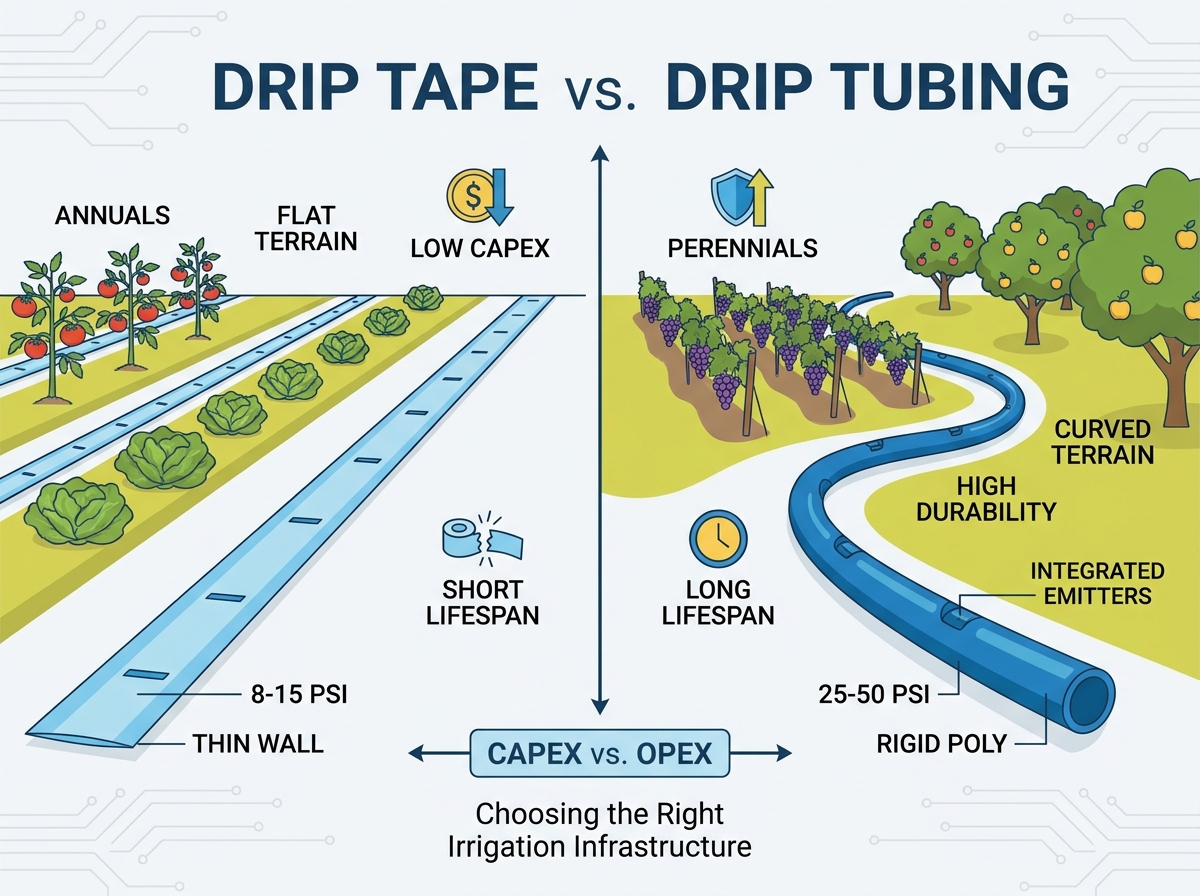
Thin wall drip tape is the industry standard for straight-row annual crops due to its ultra-low upfront cost and uniform delivery over long, flat distances.
Drip tubing (poly tubing with integrated emitters) requires a higher initial investment but provides 5–10+ years of durability, making it essential for perennial agriculture, orchards, and curved topographies.
The primary tradeoff is capital expense (CapEx) vs. operational expense (OpEx): tape often requires seasonal replacement and higher labor for installation/removal, while tubing is a “set and forget” long-term asset.
System pressure dictates the choice: tape generally requires tight pressure regulation (8–15 PSI) to avoid blowouts, whereas thick-walled tubing handles higher pressure (up to 30-50 PSI) and rugged terrain.
Understanding the fundamental engineering behind these two distinct systems prevents costly field mistakes. Manufacturers design each product to solve very specific agricultural challenges.
We define this product as flat drip tape. It expands into a round tube when pressurized by water. It lays completely flat on the soil surface when empty. Manufacturers measure the wall thickness in mils (one thousandth of an inch). You will typically see products ranging from 4 mil for single-season temporary beds up to 15 mil for multi-season setups.
Commercial operators rely heavily on standard agricultural drip tape for large-scale row crop farming. It ships in massive, tightly wound rolls. This design allows farmers to deploy thousands of feet across flat fields rapidly using tractor implements.
Drip tubing consists of rigid, cylindrical polyethylene. It maintains its round shape permanently, regardless of internal water pressure. This structural integrity defines its physical characteristics in the field.
You must understand the difference between two primary tubing categories. Blank tubing contains no holes. Farmers use blank tubing primarily as a main or sub-main distribution line. Emitter tubing features factory-spaced drippers permanently molded inside the cylinder wall. We often call this in-line dripline.
Three main mechanical characteristics separate these irrigation technologies:
Wall Thickness: Tape utilizes ultra-thin walls to maximize flexibility and minimize shipping weight. Tubing uses heavy-duty, thick walls to resist environmental stress.
Physical Flexibility: Tape lays flat and rolls easily. Tubing resists bending and requires specific techniques to coil.
Emitter Style: Tape utilizes laser-cut slits or precision-stamped labyrinth channels. Tubing relies on rigid, molded cylindrical emitters bonded directly to the inner wall.
Financial modeling dictates many farming infrastructure choices. You must evaluate the initial capital outlay against the projected lifespan of the material.
Let us break down the exact cost per foot. High-volume purchases make tape significantly cheaper. You can purchase thousands of feet per roll for minimal capital. This low price point allows farmers to outfit massive acreages on tight budgets.
Tubing requires a much higher initial layout cost. The heavy manufacturing process drives up the price per foot. You also need heavier, more expensive compression fittings to secure these lines. Small farms often feel the budget impact of tubing much faster.
We must set realistic field expectations. Insects, rodents, and mechanical strikes easily compromise thin wall drip tape. A stray hoe or a passing tractor tire will instantly destroy it. Farmers treat it as a consumable asset. Most operations discard it after one to three seasons.
Tubing offers vastly superior UV resistance. It aggressively resists crushing from foot traffic or heavy wheelbarrows. These rigid lines routinely last five to ten years in harsh environments. Even intense sunlight or shallow burial will not quickly degrade standard agricultural tubing.
Labor costs often exceed material costs over time. Tape requires heavy seasonal labor commitments. You must roll it up, store it carefully, and unroll it every single year. You lose valuable operational hours during critical planting windows.
Tubing requires intensive, one-time installation labor. Crews spend days cutting, fitting, and staking the rigid lines. However, once installed, it becomes a permanent field asset. You drastically reduce your annual setup labor.
Feature | Flexible Tape | Rigid Tubing |
|---|---|---|
Wall Thickness | 4 mil to 15 mil | 35 mil to 45 mil+ |
Physical Shape | Flat when empty | Always cylindrical |
Expected Lifespan | 1 to 3 seasons | 5 to 10+ years |
Initial Purchase Cost | Very low | Moderate to high |
Labor Commitment | High seasonal labor | High upfront, low ongoing |
You cannot force a system to perform outside its designed parameters. Selecting the right technology requires matching it perfectly to your crop type and terrain.
Certain agricultural environments practically demand flexible solutions. You will see optimal results when you match the material to specific plant lifecycles.
Ideal Crops: Annual vegetables need seasonal setups. Tomatoes, peppers, lettuce, and cut flowers thrive on these systems. Temporary market garden beds and industrial hemp operations also benefit greatly.
Ideal Layout: You need long, perfectly straight runs. The terrain should remain relatively flat. You cannot curve flexible tape easily. Bends cause kinks. Kinks cut off the water flow entirely.
Best practices dictate laying the lines straight down the center of the bed. You should stake the ends firmly to maintain tension. Loose lines will drift in the wind and deliver water inconsistently.
Permanent agricultural installations require rugged infrastructure. Rigid lines provide the necessary stability for long-term growth cycles.
Ideal Crops: Perennials require permanent hydration zones. Vineyards, commercial orchards, and berry patches represent perfect use cases. Permanent landscaping and nursery stock also rely on these heavy lines.
Ideal Layout: Many fields feature rough topography. Tubing easily handles bends, tight curves, and sudden elevation changes. Pressure-compensating options perform flawlessly on steep hillsides.
A common mistake involves using non-compensating tubing on sloped terrain. You must specify pressure-compensating emitters if your orchard features significant elevation changes. This ensures every tree receives the exact same water volume.
Theoretical performance means nothing without proper field execution. Both systems carry unique maintenance burdens. You must prepare your crew to handle these distinct daily realities.
Both systems demand strict water filtration. However, sediment and algae easily clog thin labyrinth emitters. You absolutely must install a 150-200 mesh filter at the water source. Without adequate filtration, system failure remains guaranteed.
Tubing emitters often feature superior self-cleaning mechanisms. Larger internal pathways allow minor debris to flush through safely. Yet, calcium buildup remains a shared risk across both systems. Hard well water will calcify emitters regardless of the wall thickness. You may need acid injections to clear heavy mineral deposits.
You must understand the strict pressure tolerances of flexible lines. Pushing 20 PSI through an 8-mil product guarantees catastrophic seam blowouts. You must regulate the system down to 8-15 PSI strictly. A failed pressure regulator will destroy an entire field of tape instantly.
Tubing systems act much more forgivingly under pressure spikes. They comfortably operate across a wider spectrum, often handling 30 to 50 PSI effortlessly. This durability makes them ideal for systems running directly off strong municipal water lines or large agricultural pumps.
Winterizing brings harsh realities to farm management. You can blow out rigid lines using a standard high-volume air compressor. You then leave the empty lines safely in the field beneath the snow. They resist freezing damage beautifully once evacuated.
Flexible lines demand careful handling during autumn teardowns. You must spool the material meticulously onto large reels. Alternatively, many operators simply pull it up and discard it into dumpsters. Improperly stored rolls will degrade in hot barns and attract nesting mice over the winter.
We designed this framework to remove the guesswork from your purchasing process. Evaluate your current operational habits against these structured criteria.
You actively rotate crops and change your bed layouts every single season.
You manage large, completely flat acreage.
You desperately need to keep initial infrastructure costs as low as possible.
You possess the labor capacity to lay, pull, and dispose of lines annually.
Your water source allows for precise, low-pressure regulation.
You are establishing a multi-year permanent planting like an apple orchard or grape vineyard.
Your field layout involves curved beds, rolling hills, or heavily uneven terrain.
You want a system highly resistant to heavy foot traffic, domestic pets, and foraging wildlife.
You lack the seasonal labor required to pull up miles of irrigation line every autumn.
You plan to cover the lines permanently with heavy organic mulch or crushed stone.
Do not guess your requirements. We recommend buyers perform a strict audit of their primary water source first. Check your available gallons per minute and your resting PSI. Measure the total linear footage required for your upcoming planting blocks. Evaluate your multi-year operational budget strictly before ordering materials. Proper measurement prevents wasteful over-ordering and ensures adequate pressure across the entire farm.
We must summarize one vital truth about agricultural irrigation. No universal "better" option exists in this industry. You only find the correct tool for your specific crop and your unique financial model. Forcing the wrong product into a hostile environment always guarantees failure.
We reiterate that quality tape maximizes short-term ROI for seasonal annuals. It covers massive acreage for pennies on the dollar. Conversely, heavy tubing secures long-term stability for perennial agriculture. It withstands the brutal realities of permanent field exposure.
You must match the infrastructure directly to your operational goals. Evaluate your field layout today. Browse specific product categories based on your identified operational needs. Compare rugged rigid systems or explore flexible bulk solutions. Please contact us to discuss your exact project specifications with our irrigation specialists.
A: Yes. You use specific barbed transition fittings to bridge the two systems. Farmers frequently use rigid blank poly tubing as a reliable header or mainline. They then punch holes into the mainline and insert barbed valves to run flexible lines down each individual crop row.
A: Yes. Subsurface Drip Irrigation (SDI) remains highly common in commercial agriculture. However, it requires a much thicker product, usually 10-15 mil. You also need strict root-intrusion management. Plants will naturally seek the buried emitters and can clog them with tiny root hairs.
A: You perform repairs using simple plastic couplers. You cut out the damaged section with shears. You then insert the two cleanly cut ends into the coupler and tighten the locking nuts. This provides a cheap, fast, and permanent field repair without replacing the entire row.
A: Yes. While rigid lines handle higher pressure than flexible alternatives, they still require strict regulation. You typically need a regulator set between 25-30 PSI. Operating without one causes insert fittings to blow apart and forces emitters to deliver wildly uneven water volumes.


