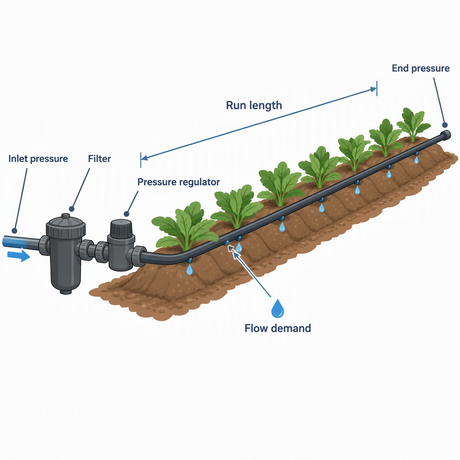
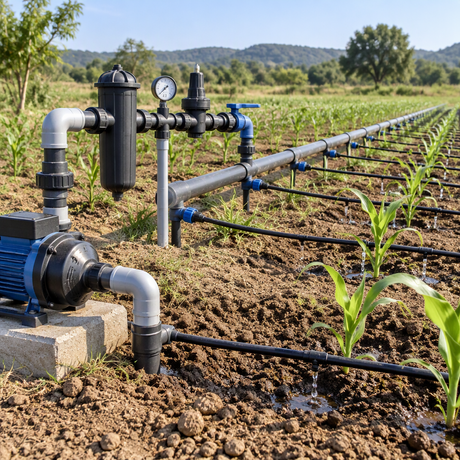
Clogging is a water-quality problem before it is an emitter problem. Drip emitters have very small waterways, commonly 0.2–2.0 mm, that become blocked when the water is not clean enough, and the potential for clogging in a drip system is closely related to water quality, with physical, chemical and biological contributors. Work the problem in order: catch partial blockage while the crop still looks healthy, identify which contributor is at work, match filtration to the real source water, and re-inspect the same zone after every change.
What Does Drip Emitter Clogging Look Like Before Plants Show Stress?
Look for uneven growth and shrinking wetting patterns rather than dead plants. A completely blocked emitter opening is easy to notice, while partial blockage is not, so the earliest reliable signal is a row, a zone or a single plant that lags its neighbours while the rest of the block looks normal. Inspect that zone while the crop is still healthy and the cause is still cheap to fix.
Uneven watering also comes from low system pressure, a damaged or kinked lateral, a partly closed valve or a layout that never delivered uniform flow, and partial blockage mimics all of them. Before ordering filters, compare the suspect zone with a healthy one: check pressure at the head of both, look for physical damage along the lateral, and note whether the under-watered plants follow the pipe run or appear in patches. A dry corner is a symptom, not a verdict, and no single remedy covers physical, chemical and biological causes.
Which Causes of Drip Emitter Clogging Should You Rule Out First?
Rule out three groups in order: physical, chemical and biological. Each group needs a different response, so identifying it before you buy equipment matters more than the equipment label. Emitter waterways of only 0.2–2.0 mm can be blocked by algae, fertiliser deposits and dissolved chemicals such as calcium and iron that precipitate out of the water.
| Cause group | Field sign | First check | First action |
|---|---|---|---|
| Physical | Sand, silt and organic debris reaching the laterals; grit in the filter; filter elements loading quickly | Open the filter and read what it captured, then inspect the end of a suspect lateral | Improve pre-filtration and protect the intake |
| Chemical | Rust-coloured or chalky scale on emitters and lateral walls that returns after cleaning | Water analysis for iron, hardness, bicarbonates and pH | Keep precipitates out of the irrigation line: oxidise, precipitate and filter iron, and manage pH |
| Biological | Green or brown film and slippery growth inside laterals, filters and tanks | Inspect filter media, tank walls and the inside of a lateral end | Reduce the organic load and treat the water |
In What Order Should You Diagnose a Clogging Zone?
Work outwards from the source: confirm the symptom is blockage rather than pressure or design, inspect what the filter has captured, review the water analysis, then decide whether the deposit is physical, chemical or biological. Cheap checks first stop you from buying filtration you do not need.
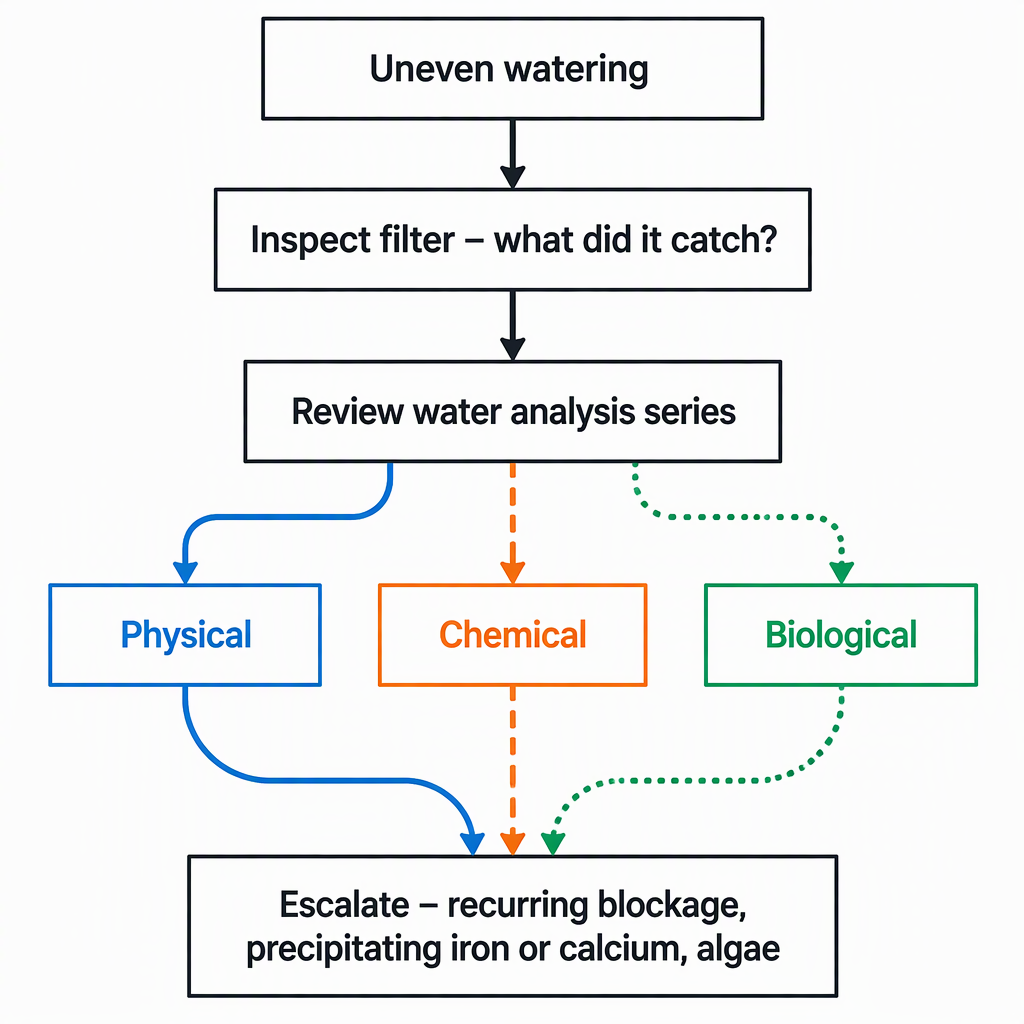
- Verify the symptom. Compare the suspect zone with a healthy one while the system runs: check head pressure, look for a damaged lateral or a partly closed valve, and note whether the weak plants follow the pipe run or sit in patches.
- Isolate energy before any manual access. Switch the system off at the controller and disconnect the power supply to the pump, the controller and any automatic self-cleaning filter or dosing unit, then follow the manufacturer's manual for the access it permits. Never open a filter housing, dosing unit or valve chamber while the system is live.
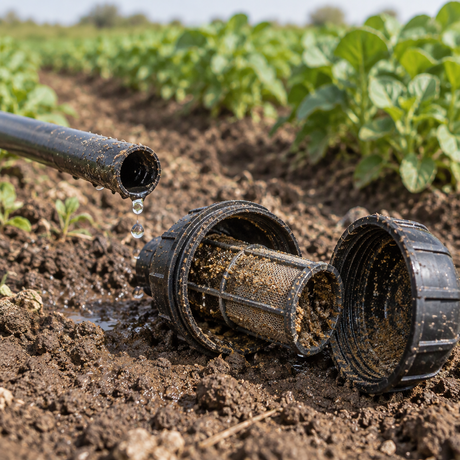
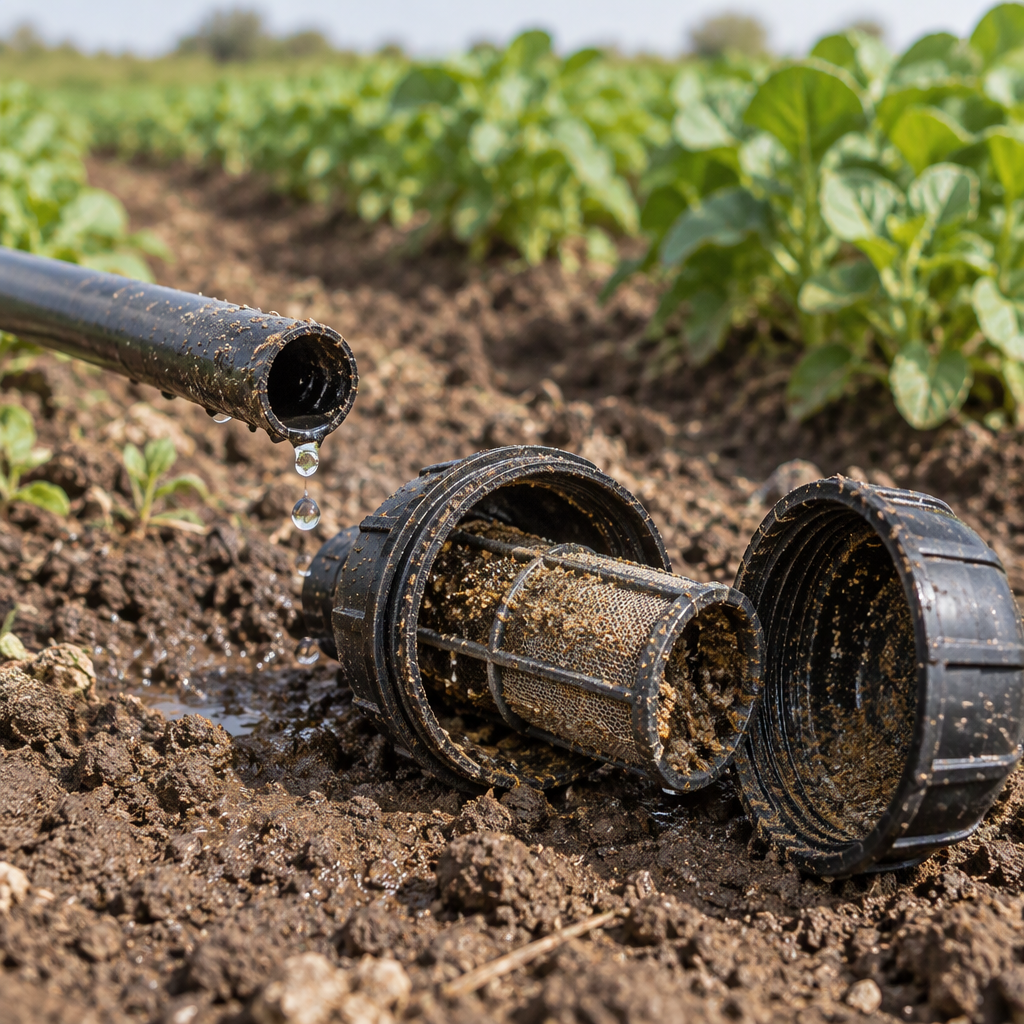
- Open the filter and read what it caught. Grit and sand point to a physical load, rust-coloured or chalky deposits to water chemistry, and slime or algae to biological growth. Record how much was there and how long it took to load.
- Compare the far ends of two laterals, one in the affected zone and one in a healthy zone, and inspect emitter outlets and the inside wall. Record whether blockage is uniform along the zone or scattered between plants, because that pattern is one of the first things a specialist will ask about.
- Review the analysis series rather than one sample, and match iron, hardness, bicarbonate and pH values against what the deposits suggest. Where the source is surface water, quality can change considerably within a single irrigation cycle, so a series shows what the system really receives.
- Correct one thing, then re-check the same zone after one or two irrigation cycles. Recurrence in the same place means the cause was not fully addressed.
Why Is One Irrigation Water Test Not Enough for a Drip System?
Because water quality can fluctuate considerably within a single irrigation cycle, especially where the source is surface water. One sample describes one moment; a series taken across the season describes what the system actually receives, which is what filtration and treatment decisions have to be built on.
- Ask the laboratory for the standard water-quality test set used for the design and operation of localized (drip) irrigation systems, rather than a general irrigation panel.
- Sample repeatedly rather than once, and more often where the source is a pond, canal or river.
- Focus on the parameters that match your deposit: iron, hardness, bicarbonate and pH where emitters show rust-coloured or chalky scale.
- Sample again after any source change, such as a new well, dredging, a different pump setting or the start of an algae season.
- Keep every report with the system documentation, so the next analysis and the next technician start from data instead of guesswork.
- Treat heavy loading as a design input for your filter and emitter supplier, not something to correct by adjusting injection rates on trial and error.
Which Filtration Setup Matches Your Actual Water Source?
Match the barrier to what the water actually carries. FAO's drip irrigation chapter states that filtration is needed wherever the water is not free of sediments, and screening alone is not adequate in every case, because small particles can still pass through screens; the finer route is removal through a suitable medium, normally graded sand.
| Water source | Main load to control | Route to discuss with your supplier | Limit to plan for |
|---|---|---|---|
| Well or borehole | Fine mineral grit, occasionally iron | Screen or disc filtration at the head, with graded sand media where the analysis shows iron or fine silt | Iron has to be oxidised, precipitated and filtered out before it enters the irrigation line; iron above about 2.0 mg/l is already near the practical maximum for drip systems because filtration costs rise |
| Pond, canal or river | Algae, organic debris and sediment that change with the season | Coarse protection ahead of graded sand media, plus source management and a realistic cleaning routine | Quality varies within a single irrigation cycle, so the design should follow a series of analyses rather than a single sample |
| Heavily sediment-laden source | High, continuous sediment load | Reconsider the method before sizing filters: where irrigation water contains much sediment, FAO notes that surface irrigation is preferred because sediment can clog drip and sprinkler systems | If drip is still required, expect heavier filtration and more frequent maintenance |
Filtration and emitters are often specified by different people, so the interface deserves a direct question: which filter is intended for this emitter under this water analysis? A supplier that builds both can answer it from one specification. DFSHOU, for example, manufactures screen, disc, sand media and automatic self-cleaning disc filters alongside drip emitters, and states that it supports projects with layout design and product selection guidance.
How Do You Stop Chemical and Biological Clogging From Recurring?
Treat the water and keep precipitates out of the line; cleaning emitters only resets the clock. FAO's Irrigation and Drainage Paper 29 advises oxidising, precipitating and filtering iron before it enters the irrigation line, and describes continuous acid injection that holds pH close to but not lower than 6.5.
Chemical and biological control is operator work, not a field experiment. Acid and chlorine dosing are hazardous: use the correct personal protective equipment, keep incompatible chemicals apart, follow the dosing equipment supplier's instructions and local handling rules, and isolate and depressurise the injection line before servicing a dosing pump or opening any housing.
Two fertiliser effects are worth checking against your analysis. Where calcium exceeds about 6 me/l, most phosphorus fertilisers can clog emitters, and the problem is more severe where bicarbonates exceed 5 me/l. Where iron is high, look at the source first, because iron above roughly 2.0 mg/l is already near the practical maximum for drip systems.
For biological growth, the same FAO water-quality paper carries a chlorine-dosage table for controlling growths in drip systems. Ask your supplier or water-treatment adviser for the dose that matches your own analysis and organic load rather than estimating one, and re-inspect the lateral after treatment.
When Should You Stop Adjusting and Call an Irrigation Engineer?
Stop adjusting when the same zone clogs again after you have corrected the obvious cause, when the analysis confirms iron, calcium or heavy biological growth, when deposits appear across the whole system instead of one zone, or when more than one contributor group is clearly present. At that point the fix is a system decision — filtration, water treatment or emitter choice — not another field adjustment. Preventive equipment installed at the outset is usually less expensive than correcting clogging afterwards, and there is not enough field experience with drip systems to predict precisely if or when clogging will occur, so waiting for a definite answer is itself a cost.
- Ask for the water analysis series, with sampling points and dates.
- Describe the source: well, canal, pond or recycled water, and how it changes across the season.
- Report what the filters captured, how quickly they loaded, and how they were cleaned.
- Give the emitter and lateral specification, with the filtration requirement the manufacturer states for that emitter.
- Record which zones clog, and whether blockage is uniform along a lateral or scattered between plants.
- List the corrections already attempted, and the result of re-inspecting the same zone afterwards.
Keep the scale of the problem in view: because emitter waterways may be only 0.2–2.0 mm across, a change that looks minor in the mainline — a little sediment, a slightly different iron level — can be decisive at the emitter.
Conclusion: Fix the Water, Not Just the Emitter
Emitters do not clog because of the emitter; they clog because the water reaching them carries sediment, dissolved minerals or biological growth into passages a fraction of a millimetre wide. A workable drip irrigation clogging prevention routine is water-first: catch partial blockage while the crop still looks healthy, decide which contributor group is at work, characterise the source with a series of analyses instead of a single sample, match filtration to what that water carries, and re-inspect the same zone after every change.
It is also worth budgeting for prevention rather than repair. Installing proper preventive equipment when the system is designed is usually less expensive than correcting a clogging problem later — and since clogging cannot be predicted with precision, a system that is easy to inspect, clean and re-check is the practical insurance.
Frequently Asked Questions
Short answers to the questions dealers, project engineers and buyers raise most often when emitters start to under-perform. Where an answer depends on your own water, the analysis comes before the purchase.
How often should the irrigation water be tested, and why is one sample not enough?
Treat testing as a series, not a one-off. Water quality can fluctuate considerably within a single irrigation cycle, especially from surface water, so analyses taken across the season show what the system really receives.
Is a screen filter on its own enough to protect drip emitters?
Not always. Screens stop larger debris, but small particles can pass through the mesh, which is why removal through a suitable medium, normally graded sand, is described as the finer route. Choose the barrier from your water analysis.
What iron concentration should trigger concern in a drip system?
FAO treats an iron concentration above about 2.0 mg/l as near the practical maximum for drip systems, because filtration costs rise. Iron should be oxidised, precipitated and filtered out before it enters the irrigation line.
Can injected fertiliser cause emitters to clog?
It can. Where calcium exceeds about 6 me/l, FAO notes that most phosphorus fertilisers can clog emitters, and the effect is more severe where bicarbonates exceed 5 me/l. Check both values before changing your injection programme.
What pH should acidification of irrigation water target?
FAO describes continuous acid injection that holds pH close to but not lower than 6.5. The set point still depends on your water, crop and dosing equipment, so follow the equipment supplier's instructions for the value you use.
Can saline water be used safely through drip irrigation?
That is a water-quality decision rather than an emitter decision. Emitter waterways are still only 0.2–2.0 mm and block when the water is not clean enough, so base the choice on a full analysis series, your crop and soil, and local advice.
How small are the water passages inside an emitter?
FAO's irrigation-methods manual describes drip emitter waterways of roughly 0.2–2.0 mm. Grit, precipitates and biological film that pass easily through a mainline can still block an emitter.
Can anyone say precisely when a system will start clogging?
No. FAO states that there is not enough experience with drip systems to predict precisely if or when clogging will occur. Monitoring, analysis and maintenance are what keep emitters flowing.