English


Views: 0 Author: Site Editor Publish Time: 2026-10-13 Origin: Site


Drip irrigation flow rate helps you choose drip tape and a filter that can work together. In a vegetable field or greenhouse bed, closer emitter spacing can help water reach more of the root zone. It also puts more emitters on each row. If the output per emitter stays the same, the filter must handle more water even though the rows are the same length.
Start with a drip tape that fits your crop layout. Then calculate how much water the active rows will draw and use that figure to shortlist filters. The final choice also depends on the tape’s filtration requirement, the quality of your source water, and the pressure available at the tape inlet.
Choose emitter spacing for the root zone and use the emitter output at your planned operating pressure.
Calculate the flow of the rows that run together. If several zones share a filter and run at the same time, add their flows.
Match the filter grade to the tape, the filter type to the water source, and the filter capacity to the highest simultaneous flow.
Start with the bed width, crop spacing, and the way water spreads through the soil. Closely planted beds may need closer emitter spacing to form a continuous wetted strip. Check the wetting pattern in a representative bed before settling on the tape. The same spacing can wet different widths in different soils.
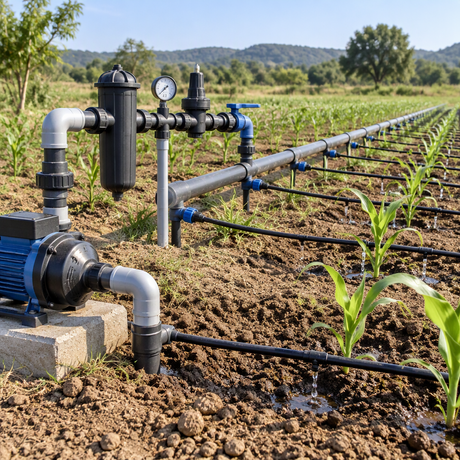
Then compare emitter output at the pressure you expect at the tape inlet. DFSHOU’s 16 mm flat inlaid drip tape is available with 200 mm and 300 mm emitter spacing, among other options. The 2.2 L/h version delivers 2.20 L/h per emitter at 0.8 bar under the stated test conditions. This gives you a starting point for estimating zone flow.
Check the longest individual row against the recommended lateral length for your tape configuration. In an open field, long rows and elevation changes can affect pressure along the tape. In a greenhouse, short beds can still create high demand when many beds run together. Check both the individual row length and the total tape length served by each valve.
For rows using the same tape, count the emitters on all rows that run together. For a preliminary estimate, divide the total active tape length by emitter spacing in the same units. Multiply by the output per emitter in L/h, then divide by 1,000 to get m³/h for comparing filters.
Consider a zone with 18 rows, each 60 m long. Both tape options below use emitters delivering 2.2 L/h at 0.8 bar.
Tape configuration | Estimated active emitters | Estimated zone flow |
|---|---|---|
300 mm spacing | 3,600 | 7.92 m³/h |
200 mm spacing | 5,400 | 11.88 m³/h |
Moving to 200 mm spacing increases the estimated flow by 50%. If the closer spacing suits the crop, carry the higher flow into your filter selection. If the water supply or filter capacity limits the layout, check whether running fewer rows at a time would let you keep the closer spacing.
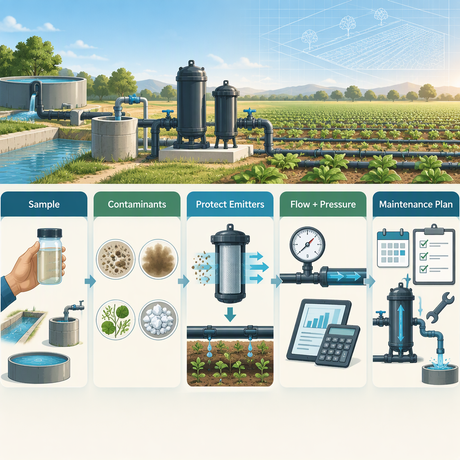
The DFSHOU flat inlaid drip tape in this example calls for 120 mesh minimum filtration. Use that requirement to select the filtration grade. Then look at what the water carries. A screen filter can suit relatively clean water with light mineral sediment. A disc filter may be a better candidate when the water contains organic debris. Heavy sediment or algae can call for a separate pretreatment stage. For more on that decision, see the filter selection guide by water source.
In the DFSHOU 120 mesh plastic filter range, the 2-inch DFS-Y63/A disc filter has a maximum flow rating of 10 m³/h. The 7.92 m³/h layout is within that rating. The 11.88 m³/h layout exceeds it. The 2-inch DFS-Y63/M screen filter is rated for up to 15 m³/h, so it remains a candidate for the higher-flow layout if the water suits screen filtration.
Before ordering, check the filter’s pressure drop at your design flow and allow for the additional loss as the element collects debris. Confirm that enough pressure remains downstream to feed the tape. If you choose an automatic filter, also verify the available pressure and flow during its cleaning cycle.
Start with the drip tape that fits the crop and row layout. Use its emitter spacing and output to estimate the highest flow the filter will see. Then check filtration grade, water quality, and pressure loss before finalizing the pair. This gives you a practical way to compare DFSHOU drip tape and filter configurations for field rows or greenhouse beds.
Need help matching drip tape and filters for your project?
You may be able to keep it if it meets the new tape’s filtration requirement and can handle the revised flow at an acceptable pressure drop. Recheck the filter whenever emitter spacing, emitter output, or the number of active rows changes.
Calculate the flow for each tape type using its own emitter spacing and output at the expected pressure. Then add the results for the rows that run together.
For individual pot drippers, count the active emitters directly and multiply by their output. If one emitter feeds several outlets, use the rated flow of that emitter as the starting point and confirm how the outlets divide the flow.
If only one zone runs at a time, use the flow of the largest zone served by the filter. If zones overlap, use the combined flow of the highest-demand group that can run together.